




Car leasing in Poland or long-term rental? If you want to own the car in the end, choose consumer leasing with a buyout or a car loan. If you need a car for a few months, or you have no credit history in Poland, long-term rental from a rental fleet is usually the better fit. A car subscription makes sense when you plan to drive for at least 2 years and want servicing, insurance and tyres in one monthly fee.
Leasing vs long-term rental vs subscription: comparison
In Poland, "long-term rental" (wynajem długoterminowy) can mean two different products. One is a new car from a finance operator, usually for 24-60 months. The other is a car from a rental company's fleet for as many months as you need. The table keeps them apart.
| Feature | Consumer leasing | Operator long-term rental | BLS fleet rental | BLS subscription |
|---|---|---|---|---|
| Contract length | usually several years | usually 24-60 months | from a few days, no upper limit | at least 24 months |
| Credit check (BIK) | yes - required by law for leasing with a mandatory buyout | usually yes | no | yes |
| Down payment | depends on the offer | depends on the offer | none; deposit on the Base plan, none on Prime | none; first and last two months paid upfront |
| Car owner | the lessor, you after the buyout | the operator | the rental company | BLS |
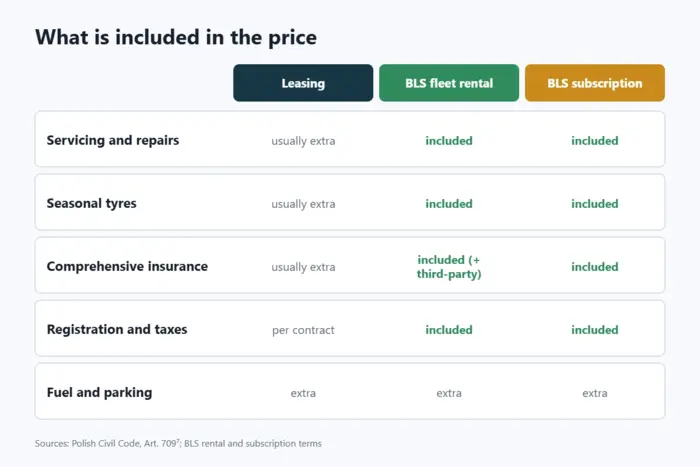
| Servicing, tyres, insurance | usually paid by you | depends on the package | included: servicing, seasonal tyre change, third-party and comprehensive insurance | included: servicing, tyres, comprehensive insurance, registration and taxes |
| Mileage | depends on the contract | usually capped in the contract | Base 250 km per day, Prime unlimited | unlimited |
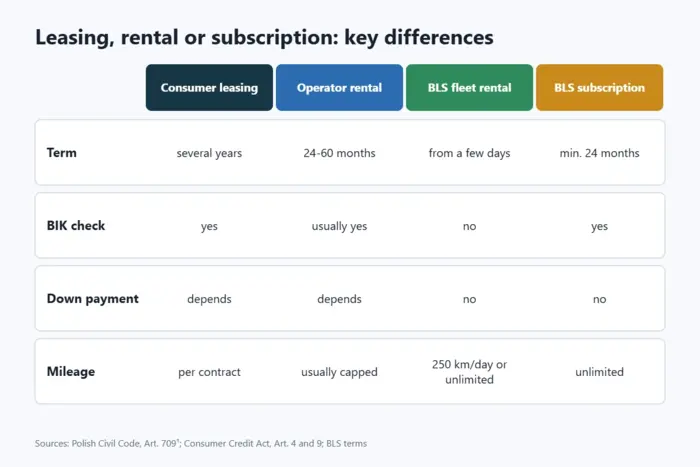
An operator's monthly payment is usually lower than a lease payment because you do not pay off the full value of the car. If you want to buy it at the end, the total cost usually comes out higher, and on return you may pay extra for excess mileage or wear.
Car leasing in Poland: how it works
In a lease, the finance company buys the car and lets you use it for a set period while you pay for it in instalments (Polish Civil Code, Article 7091, in Polish). The lessor owns the car throughout the contract, but you have to look after it, including maintenance and repairs, unless the contract says otherwise (Article 7097).
If the contract requires you to buy the car at the end, Polish law treats it as consumer credit. The leasing company must then assess your creditworthiness before signing, usually based on proof of income and databases such as BIK, the Polish credit bureau (Consumer Credit Act, Articles 4 and 9, in Polish).
- When leasing pays off: you want to own the car after a few years and have a stable income and a good credit history in Poland.
- Downsides: a long commitment, a credit check and often a down payment. You usually pay for servicing and insurance yourself, and ending the contract early can be expensive.
- Tax: a private person without a business cannot deduct lease payments as costs.
Foreigners who have just moved to Poland often find leasing hard to get without Polish income or credit history. Before renting instead, check whether your licence is valid here - see our guide to driving in Poland with a foreign licence.
Long-term car rental: how it works
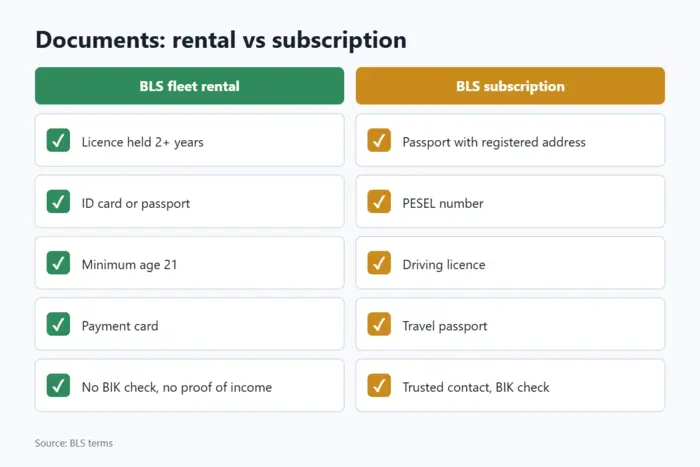
Long-term rental from a rental fleet means using a ready car for months or years - without buying it, taking a loan or waiting for delivery. At BLS we do not check BIK and do not ask for proof of income or a down payment. You need:
- a valid driving licence and an ID document;
- to be at least 21 and have held a licence for at least 2 years (25 and 3 years on the Prime plan);
- a payment card with enough funds for the payment and any deposit.
The price includes VAT, full servicing, seasonal tyre changes and third-party and comprehensive insurance. Fuel, parking and road tolls are paid by you. You can extend the contract for as long as you need the car - there is no upper limit. See the cars and details on our long-term car rental page.
Downsides of long-term rental
- You never own the car, so after years of payments you have no vehicle of your own.
- Over a very long period the total cost can be higher than buying a car outright.
- The Base plan has a deposit and a 250 km daily limit - choose Prime if you drive a lot.
- Driving abroad requires the rental company's prior written consent.
How much does long-term car rental cost?
It depends on the car class, the plan and the rental length. At BLS the lowest daily rate in the catalogue applies to rentals of 29 days or more, and longer contracts get an individual quote for the whole period. How to compare daily, weekly and monthly costs is explained in our guide on how much car rental costs, and how a deposit differs from an excess in our guide to car rental deposits.
Car subscription: is it worth it?
A car subscription is a fixed monthly fee that already covers the cost of running the car. With a BLS subscription:
- Term: a contract for at least 24 months.
- Cars: new and used, passenger cars and vans. You can switch to another brand during the contract.
- Included: servicing, seasonal tyre change and storage, comprehensive insurance, registration and taxes, protective film and 10 days a year with a premium car.
- Mileage: unlimited.
- Payment: no down payment. You pay the first and the last two months upfront, then just the monthly fee.
- Checks: we check BIK.
For the contract, prepare a copy of your passport with your registered address, your PESEL number, a copy of your driving licence, a copy of your travel passport for trips abroad, and the name and phone number of a trusted person. Companies can subscribe too. See the details on our car subscription page.
Which is better: leasing, rental or subscription?
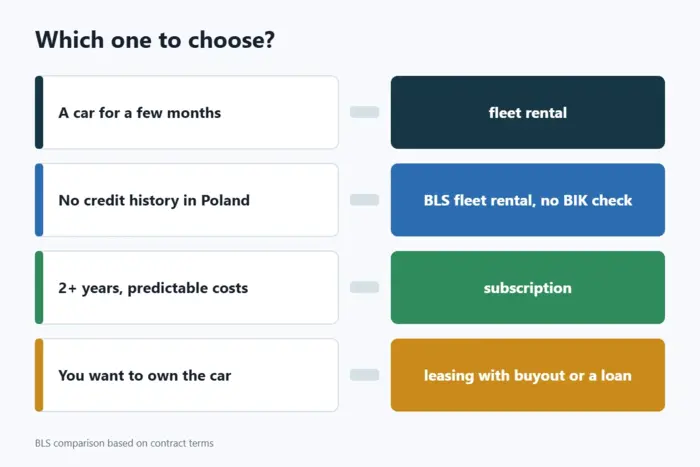
- A car for a few months - a move, a project or a repair of your own car: fleet rental. You pay only for the time you need and are not tied in for years. For shorter periods, see how to rent a car for a month in Warsaw.
- No credit history in Poland, or you do not want a BIK check: BLS fleet rental with no BIK check, down payment or proof of income.
- At least 2 years with predictable running costs: a subscription - one fee covering servicing, tyres, insurance and taxes, with unlimited mileage.
- You want to own the car: consumer leasing with a buyout or a car loan. Compare the total cost, not just the monthly payment.
Before signing, check what happens if you end the contract early. With leasing and operator rental this often means extra costs, while fleet rental simply ends with the agreed period.
FAQ
Is a car subscription worth it?
It is worth it if you need a car for at least 2 years and want predictable costs: servicing, tyres, insurance and taxes are in one fee, and BLS has no mileage limit. If you want to own the car, leasing with a buyout or a loan is the better route.
What is the difference between leasing and long-term rental?
With leasing you pay off the value of the car and can usually buy it, while servicing and insurance are mostly on you. With rental you pay to use the car, and servicing, tyres and insurance are usually included.
Can a foreigner lease a car in Poland?
Yes, but the leasing company must assess your creditworthiness, which usually needs Polish income and documents. Without them, renting from the BLS fleet without a BIK check is easier.
Is there a mileage limit on a car subscription?
Not with BLS. On fleet rental, the Base plan includes 250 km per day and Prime has unlimited mileage.
Can a private person deduct lease payments from tax?
No, not without running a business. Private individuals cannot deduct lease payments as costs.