



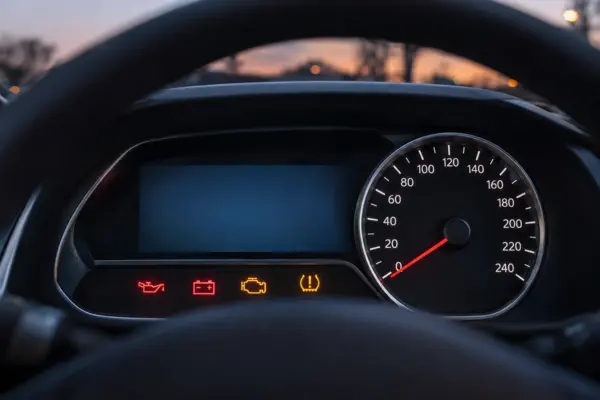
Dashboard warning lights are easiest to read by colour. Red means a serious fault or danger, so if the oil, temperature, charging or brake light comes on, stop somewhere safe and do not drive on. Amber or orange warns that a system may fail and usually lets you drive carefully to a workshop. Green and blue only tell you a function is on. The exception is a flashing check engine light, which also means you should stop. Below is a table of the 14 most important warning lights and what to do if one comes on in a car rented in Warsaw.
Dashboard warning light colours: what they mean
Manufacturers use the same system. Kia describes it like this: a red light signals a direct danger to people or a risk of serious damage, amber a problem that may lead to a system failure, green an active system and blue a function that is switched on. Kia lists all symbols for its models on its warning lights page (in Polish).
Right after you start the engine, many lights come on for a moment. This is a bulb and sensor check. All warning lights should go out after start-up, and any that stay on indicate a fault.
The most important dashboard warning lights: a table
| Warning light | Colour | What it means | What to do |
|---|---|---|---|
| Oil pressure (oil can) | red | oil pressure or level too low | stop, switch the engine off, do not drive on |
| Coolant temperature (thermometer) | usually red | the engine has overheated | do not continue, stop and switch the engine off |
| Charging (battery) | red | charging fault: alternator, belt or battery | stop at the nearest safe place |
| Brake system (exclamation mark in a circle) | red | parking brake on, or low brake fluid | release the brake; if it stays on, stop and do not drive |
| Airbag | red | airbag fault if it does not go out a few seconds after start | to a workshop as soon as possible |
| Power steering | red | electric power steering fault | to a workshop as soon as possible; steering may be heavy |
| Check engine, steady | amber | engine or emissions fault | drive calmly to a workshop |
| Check engine, flashing | amber | cylinder misfire | pull over somewhere safe |
| ABS | amber | ABS fault; normal brakes still work | drive carefully to a workshop |
| ESP / ESC | amber | flashing: the system is stabilising the car; steady: fault | flashing: ease off; steady: workshop |
| Tyre pressure (TPMS) | amber | low pressure in at least one tyre | check and inflate the tyres |
| Glow plugs (diesel) | amber | before start: preheating; while driving: fault | before start, wait for it to go out; on the road, workshop |
| DPF (diesel) | amber | the particulate filter is full of soot | drive about 25 minutes above 60 km/h; if it stays on, workshop |
| AdBlue | amber | low AdBlue level | top up AdBlue |
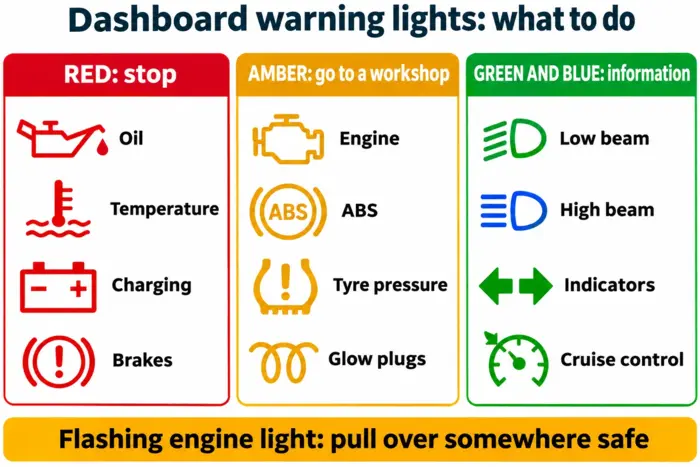
Symbols and colours can differ slightly between brands, so check the car's manual if you see an unfamiliar light. It may be a printed booklet or part of the infotainment menu.
Red warning lights: when to stop straight away
The oil light means oil pressure is too low. Driving on can damage the engine, so stop and switch it off. The coolant light means the engine is overheating, and the battery light means a charging fault, so the battery is no longer being charged. A red exclamation mark in a circle after you have released the parking brake can mean low brake fluid, and if the brakes feel weaker, do not drive on.
Amber warning lights: when you can keep driving
With a steady amber engine light (check engine) you can usually drive to a workshop, but driving with it for a long time can damage the exhaust system. If the engine light flashes, the engine computer has detected a misfire and you should pull over somewhere safe. The ABS light means your brakes work, but without ABS, and a flashing ESP light only shows that the system is working.
In a diesel, the DPF light usually goes out after a longer drive: the manufacturer recommends about 25 minutes above 60 km/h at 1,500-2,500 rpm. The AdBlue light reminds you to top up the fluid, and the amber tyre pressure light to check your tyres at the nearest fuel station.
A warning light in a rental car: what to do
- Stop somewhere safe, switch on your hazard lights and, if you are on the road, set up the warning triangle. The rules are in our guide to mandatory car equipment.
- Take a photo of the dashboard showing the warning light and the mileage.
- Call us before you order a tow truck or go to a workshop. The numbers are in your rental agreement and on our contact page.
If it is a technical fault of the car rather than the result of a driver's mistake, BLS pays for towing and repair and looks for a replacement car. Do not try to clear the warning or disconnect the battery, as this makes the cause harder to find.
Frequently asked questions
Can I drive with the amber engine light on?
If it is steady, usually yes, calmly to a workshop. If it flashes, pull over somewhere safe, because the engine is misfiring.
What does the red oil light mean?
Oil pressure is too low. Stop, switch the engine off and do not drive on until the cause has been fixed.
Why do all the lights come on when I start the engine?
It is a system check. Warning lights should go out a few seconds after the engine starts.
Who pays if a rental car breaks down?
At BLS, if the car has a technical fault, the rental company pays for towing and repair. Call us first, before you order roadside assistance.