



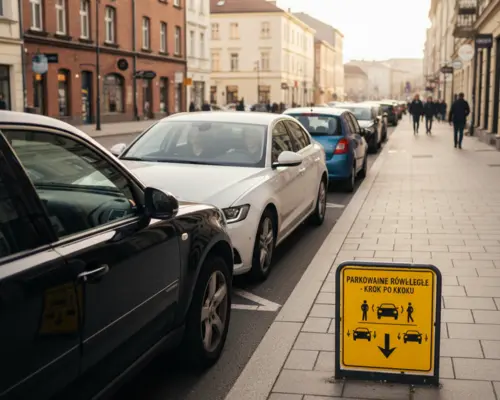
Parallel parking is a fundamental skill in city driving and one of the key elements verified during the state driving examination. In practice, it's not just about "fitting into a gap," but about positioning the car parallel to the curb or the line marking the space, as close as possible to the edge of the road. In examination settings, the goal is a precise, clean positioning-one where the vehicle's position is safe and compliant with regulations.
Definition of Parallel Parking
Parallel parking is the act of positioning a vehicle in a parking space parallel to the curb or the line marking the bay, as close as possible to the edge of the road, and without obstructing the flow of other traffic participants. The goal is to safely occupy the gap so that the wheels and bodywork do not run over the curb or markings, and the vehicle does not stick out beyond the boundary of the space.
In examination practice, a precise, "clean" positioning is required: the car should be parallel and close to the curb; the aim is for a very small working distance (about a few to a dozen centimeters), without contact with the curb, and with a minimal number of movements. On a public road, additional adjustments are permissible, provided they do not obstruct traffic and the maneuver is executed safely.
Key elements of the definition in a nutshell:
- Parallel alignment relative to the curb/space marking,
- The smallest possible, but safe, distance from the edge of the road (without contact with the curb),
- No driving over the curb/lines, no collision with adjacent vehicles,
- Control of surroundings and smoothness of the maneuver; during the exam - minimal number of adjustments.
Why is Parallel Parking Sometimes Difficult?
Psychology and Environmental Pressure
This maneuver is often performed under pressure: a car behind us, a narrow gap, pedestrians nearby, limited time. Many drivers start to rush, resulting in turning too early or too late and chaotic "sawing" of the steering wheel. Pressure also leads us to stop controlling our surroundings-mirrors, blind spots, and reversing speed.
Vehicle Geometry and Visibility
Pillars, blind spots, car dimensions, and the angle of approach relative to the gap work against us. In practice, you have to "compose" the path of travel from several phases, and each depends on the previous one: if the starting distance from the vehicle in front is wrong, the turning point will "fall apart," and correction will be more difficult.
How to Lower the Difficulty Threshold
A cool procedure and constant reference points help:
- Don't start without a full 360° observation and signaling,
- Maintain a starting distance of 50-70 cm from the car parked in front of the gap,
- Work at a low speed in reverse-time is on your side,
- Plan the adjustment before you start: know when to straighten and how to arrive parallel to the curb.
Parallel Parking Step-by-Step (Technique)
Phase 1: Positioning and Signaling
Drive up parallel to the vehicle in front of the gap. Leave a lateral distance of 50-70 cm. Turn on your right turn signal. Before shifting into reverse, check your mirrors and blind spot-reversing must not create a hazard.
Phase 2: Reversing and the Key Turn
Start reversing with the wheels straight. When the rear pillar of your car aligns with the rear of the vehicle next to you, turn the steering wheel all the way to the right. Continue reversing slowly. The car should position itself at an angle of about 45° to the curb-this is the moment when you can see the rear "falling" into the gap, and the front clearing the bumper of the car in front.
Phase 3: Straightening and Parallel Alignment
When the front of your car passes the rear bumper of the vehicle parked in front, turn the steering wheel all the way to the left. This will bring the front axle off the road and allow the car to be positioned parallel to the curb. Monitor the distance from the curb in the right mirror and the distance to the neighbors' bumpers.
Phase 4: Adjustments and Completion of the Maneuver
If the position is not ideal, make minor adjustments by gently moving the car forward or backward and guiding with the steering wheel. Ultimately, the car should be parallel and as close as possible to the edge of the road. When finished, apply the parking brake and shift into neutral.
How to Parallel Park in Reverse? (Checklist)
- Stop parallel to the car in front of the gap, leaving 50-70 cm of distance.
- Turn on the right turn signal, check mirrors and blind spot.
- Shift into reverse, start backing up with the wheels straight.
- When the rear pillar of your car aligns with the rear of the car next to you-turn fully to the right.
- Reverse slowly until the car is positioned at an angle of ~45° to the curb.
- When the front of your car passes the rear bumper of the car in front-turn fully to the left.
- Control the distance from the curb and neighboring cars; align yourself parallel.
- Make minor adjustments forward/backward if necessary.
- Finish: parking brake, neutral, wheels straight.
This list organizes the sequence and enforces a calm pace. Practice makes the turning points intuitive.
Parallel Parking in the Driving Exam (WORD)
In the examination, the rules are rigorous and "black-and-white." Precision and a minimal number of movements are important. The examiner allows one path adjustment-exceeding this limit means failing the task. Driving onto the curb or the line marking the bay is a critical error and an immediate end to the attempt. In street traffic, you can make more adjustments as long as you don't obstruct others-in the exam, the cleanliness of the maneuver is important.
In this context, it is worth organizing documents and their naming conventions in advance-questions about numbering on documents often arise during preparation. Check out the practical explanation: Driving License Number.
What Mistakes Do Drivers Make During Parallel Parking?
1. Wrong Starting Distance
Too little or too much distance from the car in front of the gap (less than 50 cm or more than 70 cm) can "take away" the space for the turn or force too large an entry angle, preventing the rear from smoothly entering the gap.
How to fix: before starting, look into your right mirror and at the edge of your fender. Position the car so that your mirrors "work"-50-70 cm is your comfort zone.
2. Turning Too Early or Too Late
The signal for the first turn is when the rear pillar of your car aligns with the rear of the vehicle next to you. Turning too early will "cut" the path and risk driving onto the curb. Too late-will force a wide arc and unnecessary corrections.
How to fix: stick to a constant reference point. If you "mismatched," return the steering wheel by a half or one turn and correct the position instead of wrestling with the accelerator.
3. Lack of Speed Control and Observation
Reversing is sometimes too fast, and the gaze "gets stuck" on only one mirror. This is a straightforward path to hitting the curb with a tire or entering the gap too deeply.
How to fix: move at a snail's pace. Work alternately with the mirrors, adding quick glances over your shoulder. Short, predictable movements are safer than one long, nervous one.
4. Lack of an Adjustment Plan
Drivers are often afraid to correct the positioning or correct "blindly." Meanwhile, a minor adjustment is a natural part of the maneuver.
How to fix: remember a simple rule-if you are too far from the curb, move the car forward by half a length and pull the front toward the curb with a small turn, then straighten again. If you are angled, straighten the wheels and make a short forward/backward adjustment without abruptly changing the turn.
5. Looking Away from the Curb at the Finish
The final centimeters determine the aesthetics and safety of the positioning. A lack of concentration results in too great a distance from the curb or scuffing the tire.
How to fix: at the end of the maneuver, look mainly into the right mirror. Aim for a clean, parallel setup-without "hugging" the curb.
Road Traffic Law (PoRD) in Practice: Where It Is and Isn't Allowed
Positioning at the Edge of the Road
The vehicle should be positioned parallel and as close as possible to the edge of the road, so as not to obstruct other traffic. Too great a distance from the curb may be considered parking that impedes traffic.
10 m and 15 m Zones
Stopping and parking are prohibited at an intersection and within a distance of less than 10 meters from it; similarly-at a railway or tram crossing and within a distance of less than 10 meters. The prohibition also applies to pedestrian crossings and bicycle crossings: stopping is not allowed on them or within a distance of less than 10 meters before them (on two-way roads with two lanes-also behind them). At public transport stops, a distance of at least 15 meters from the pole/sign is required, and in lay-bys-prohibited along the entire length of the lay-by.
Infrastructure and Residential Zones
Do not park on the lane dividing roadways or on a road/lane for bicycles. In a residential zone, park only in designated spaces marked by signs.
Parking on the Sidewalk
Permitted only for cars with a maximum permissible weight (DMC) not exceeding 2.5 tonnes. At least 1.5 meters must be left for pedestrians. Positioning: with the wheels of one side or with the front axle, if there is no prohibition-unless signs allow other configurations or the entire passenger car in a designated spot. Do not park "deep" on the sidewalk without explicit signage.
Conclusion
Parallel parking stops being stressful when you break it down into clear phases and stick to constant reference points. In the city, it's the most reliable method of utilizing tight gaps, and in the exam-proof that you control the car and the space. Practice the technique step by step, plan adjustments, work at a low speed, and adhere to the PoRD rules, and the maneuver will become routine. If you are testing maneuvers in a new car, consider short-term rental-you can easily check the dimensions and turning radius in practice, for example, in a city context like car rental in Warsaw.