



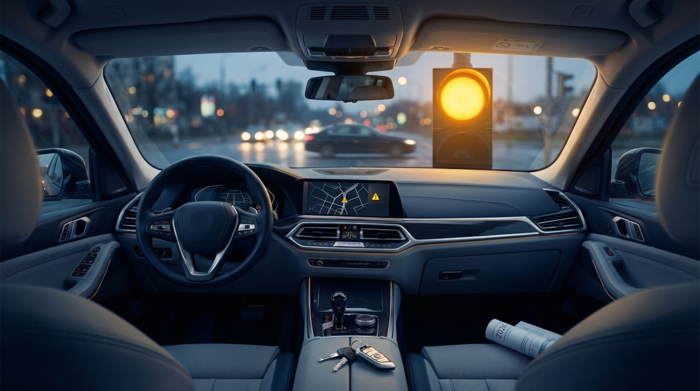
The dilemma of "brake or accelerate" upon seeing a yellow light is a daily reality for many drivers. In 2026, as traffic regulations become increasingly stringent, understanding the rules regarding running a yellow light is crucial to avoid fines and penalty points. Do you always have to stop, or are there exceptions? How do intersection cameras work, and can they record such an offense? At BLS, we ensure our clients feel confident and safe on the road. Learn how to react correctly to a yellow light and travel without unnecessary consequences by using our fleet and BLS car rental services.
Every day, thousands of drivers face a split-second decision with potentially significant financial and safety consequences. Ambiguity in interpretation and changing regulations raise many questions about running a yellow light. We have prepared this guide to resolve all doubts and provide reliable information to help you navigate the roads confidently in 2026.
Yellow Light: What Exactly Does the Road Traffic Act Mean?
Commonly referred to as an orange light, the yellow signal on an S-1 traffic light has a very precise meaning in traffic regulations. It is a warning that the green signal will soon be extinguished and the red signal will appear shortly. Essentially, a yellow signal prohibits entry beyond the traffic light.
However, as indicated by Article 99 of the Road Traffic Act, there is a key exception: you are not obligated to stop if, at the moment the yellow signal illuminates, your vehicle is so close to the traffic light that it cannot be stopped before it without sudden braking. This is where the problem of interpretation arises, as the regulations do not specify what exactly constitutes "sudden braking." This often makes the assessment of the situation dependent on the driver's individual judgment and, in case of a check, on the police officer. The purpose of the yellow light is primarily to ensure traffic flow and provide time for those who have already entered the intersection to safely clear it, and to prepare others to stop. Remember, by choosing a car from our premium fleet, you can count on advanced braking systems that will help you react safely in a critical situation.
Consequences of Running a Yellow Light: Fines and Penalty Points
Unauthorized running of a yellow light, meaning in a situation where the driver had a real opportunity to stop the vehicle safely before the traffic signal, is treated as an offense and carries specific consequences. The fine tariff in 2026 provides for financial penalties and penalty points for such behavior.
If you decide to run a yellow light despite being able to stop safely, you must expect a fine ranging from PLN 300 to PLN 500. Additionally, 2 to 6 penalty points will be added to your record. It is worth noting that stopping at a red light carries much more severe consequences - a fine of PLN 1500 and as many as 15 penalty points. If running a yellow light creates a road safety hazard, the penalty can increase to even PLN 1500. The assessment of the situation, and consequently, the decision on the amount of the fine and the number of points, depends on many factors, such as the vehicle's distance from the traffic signal, speed, prevailing road conditions (e.g., slippery surface), and the driver's overall behavior. Do not let momentary inattention expose you to such financial burdens. At BLS, we offer comprehensive car insurance that can help mitigate the effects of unforeseen events, but the best protection is always cautious driving.
Cameras and Speed Cameras: Do They Record Running a Yellow Light?
This is one of the most frequently asked questions by drivers. Does a camera at an intersection actually record running a yellow light? The common belief that cameras at intersections automatically issue fines for running an orange light is not entirely accurate.
Red Light systems, operated by CANARD (Automated Road Traffic Surveillance Center), are designed to record red light violations. They detect offenses using induction loops embedded in the road and cameras. Crucially, these systems activate only when a vehicle crosses the stop line *after* the signal has turned red. This means that automated surveillance systems *do not record* the act of running a yellow light itself; the yellow signal does not trigger the recording system.
It's different with standard speed cameras, whose primary task is speed enforcement. Can a speed camera take a picture on a yellow light? Yes, it can, but not for simply running a yellow light, but for a simultaneous speed violation. If a driver significantly exceeds the speed limit while attempting to run a yellow light, the speed camera may record the speeding offense. The fine will be issued for speeding, not for entering on an orange light. Remember, even if a camera doesn't "catch" you for running a yellow light, excessive speed is doubly risky and dangerous. By choosing a SUV from our offer, you can be sure that the vehicle will be equipped with Advanced Driver-Assistance Systems (ADAS) that will help you control your speed and ensure safety.
How to Avoid a Fine for Running a Yellow Light? Practical Tips
Avoiding a fine for running a yellow light is not just about knowing the regulations, but above all, about conscious and anticipatory driving that minimizes the risk of dangerous situations.
- Observe the light cycle: Many traffic lights have a predictable change cycle. Observe not only the lights themselves but also the surrounding traffic and pedestrian signals to anticipate upcoming changes.
- Adjust speed: Slow down as you approach an intersection, especially if the green light has been on for a while. Reduce your speed in advance so that if necessary, you can brake smoothly and safely.
- Maintain a safe distance: Keep an adequate distance from the vehicle in front (the three-second rule) to have enough space for safe braking without the risk of a collision.
- Consider road conditions: On wet, slippery surfaces, the braking distance is significantly longer. Adjust your speed and driving style to the prevailing weather conditions.
- Decision to stop: If you have any doubt whether you can safely pass before the light turns red, it is always better to stop. It is better to lose a few seconds than to risk a fine or a collision. Impulsive decisions under pressure of time or other drivers are a common mistake.
Smooth braking and acceleration not only increase safety but also driving comfort and fuel efficiency. Always be prepared for sudden changes on the road, and your journeys will be calmer.
The Role of Police and Courts in Interpreting Regulations
Despite the existence of regulations, the interpretation of yellow light situations often remains within the discretion of police officers or courts, especially concerning the imprecise term "sudden braking." The legislator has not precisely defined what "sudden braking" means, requiring common sense from both drivers and officers.
A police officer, intervening at the scene, considers a number of factors: the vehicle's distance from the traffic signal when the yellow light illuminated, speed, prevailing road conditions, and the maneuver's dynamics. Based on this information, they decide whether to issue a penalty. In case of a dispute or an appeal against a fine, the case may go to court. In such instances, evidence, such as surveillance footage (if available) or witness testimonies, may be used to assess all circumstances of the event by the judge. Remember, your behavior on the road, including calmness and politeness towards officers, can influence the course of the check. Always try to drive in a way that leaves no doubt about the safety of your maneuvers and compliance with regulations.
Running a Yellow Light in a BLS Rental Car
Renting a car from BLS is synonymous with freedom and comfort of travel, but it does not absolve the driver from the responsibility of adhering to traffic regulations. All fines and penalty points imposed for traffic violations, including running a yellow light, are the responsibility of the person driving the vehicle, not the rental company.
The driver renting the vehicle is personally responsible for all violations and associated penalties. A car rental company, such as BLS, is legally obligated to identify the perpetrator of a violation upon request from law enforcement agencies (e.g., police, CANARD). In practice, this means that a fine for running a yellow light or other violations will be issued to the driver's details, not the rental company's. Furthermore, the rental company may charge the client additional administrative fees related to handling the fine. The terms regarding responsibility for fines are always clearly defined in our car rental terms and conditions. Always treat a rented car as your own in terms of legal and financial responsibility.
Intersection Safety: Anticipation and Responsibility
The ultimate goal of all regulations and guidelines is to ensure road safety. A proactive approach, involving anticipation and responsibility, is the best strategy at any intersection.
Remember the principle of limited trust - always assume that other road users may make mistakes. Ensure smooth driving, avoid sudden maneuvers, both braking and accelerating. Always consider weather conditions, visibility, traffic intensity, and road surface conditions. Full concentration on the road allows for quicker and safer reactions to changing signals. Regularly refresh your knowledge of regulations and consciously practice defensive driving. Enjoy the comfort and performance of our cars, remembering that true driving pleasure goes hand in hand with safety.
Key Takeaways: Running a Yellow Light in a Nutshell
- Legal Definition: A yellow light generally prohibits entry beyond the traffic signal, except when a safe stop would require sudden braking.
- Fines and Points: Unauthorized running of a yellow light incurs a fine of PLN 300-500 and 2-6 penalty points; in case of creating a hazard, the penalty can increase to PLN 1500.
- CANARD Cameras: Red Light systems (CANARD) only record red light violations, not yellow light violations.
- Speed Cameras: Standard speed cameras may record speeding if you attempt to run a yellow light too fast.
- Police Assessment: The interpretation of "sudden braking" and the decision on a fine often depend on the subjective assessment of the officer.
- BLS Responsibility: The driver renting a vehicle from BLS is personally responsible for all fines and penalty points.
Need a car that can handle the challenges of the urban jungle and provide you with comfort and safety? Take advantage of our short-term car rental offer and choose a vehicle perfectly suited to your needs, with modern safety systems that support you in every road situation.
Frequently Asked Questions About Running a Yellow Light
Is "orange light" the same as "yellow light" in regulations?
No, traffic regulations exclusively use the term "yellow signal." "Orange light" is a colloquial term.
What is the fine for running a yellow light in 2026?
The fine for unauthorized running of a yellow light is PLN 300-500 and 2-6 penalty points. If a hazard is created, the penalty can increase to PLN 1500.
Do intersection cameras (Red Light, CANARD) record running a yellow light?
No, Red Light systems (CANARD) are activated only when passing a red light. They do not record instances of passing on a yellow signal.
Can a speed camera take a picture when I run a yellow light?
Yes, a speed camera can take a picture if you exceed the speed limit while running a yellow light. The fine will then be for speeding.
When can I legally run a yellow light?
You can legally run a yellow light only if, at the moment it illuminates, you are so close to the traffic signal that you cannot safely stop the vehicle without sudden braking.
What does "sudden braking" mean in the context of a yellow light?
The regulations do not specify this term. The assessment of whether braking would be sudden and dangerous depends on the circumstances (speed, distance, conditions) and is often interpreted by police officers.
Does a fine for running a yellow light in a rental car from BLS affect BLS?
No, the responsibility for the fine and penalty points always rests with the driver who committed the offense. BLS is obligated to identify the perpetrator to law enforcement agencies.
Remember, conscious and responsible driving is the key to road safety and avoiding unpleasant consequences. With BLS, you travel with confidence, knowing you have a partner by your side who adheres to clear rules and supports you in every situation.