



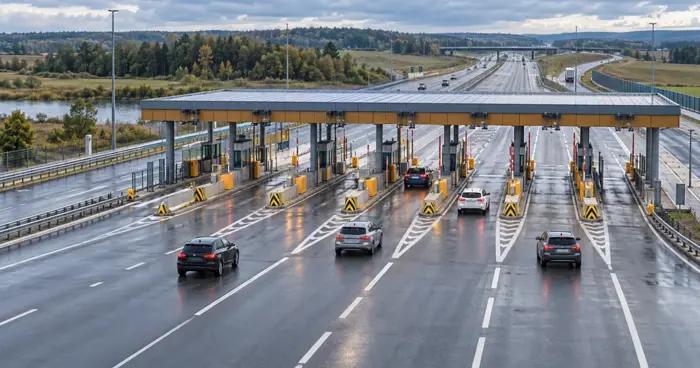
Toll roads in Poland for an ordinary passenger car mainly mean the A1 Rusocin–Nowa Wieś, A2 Świecko–Konin and A4 Katowice–Kraków sections. This does not make the entire length of each motorway chargeable. A normal car with a maximum permissible mass of up to 3.5 tonnes does not need a nationwide Polish vignette, and e-TOLL is not an app every driver must use.
This guide is for passenger-car journeys, including trips in a rental car. Identify the exact entry and exit junctions first, then the vehicle category and payment method. Rules and prices were checked on 22 October 2026. Prices below are one-way amounts for an ordinary two-axle car without a trailer, in the relevant operator’s category 1.
Which toll roads in Poland charge passenger cars?
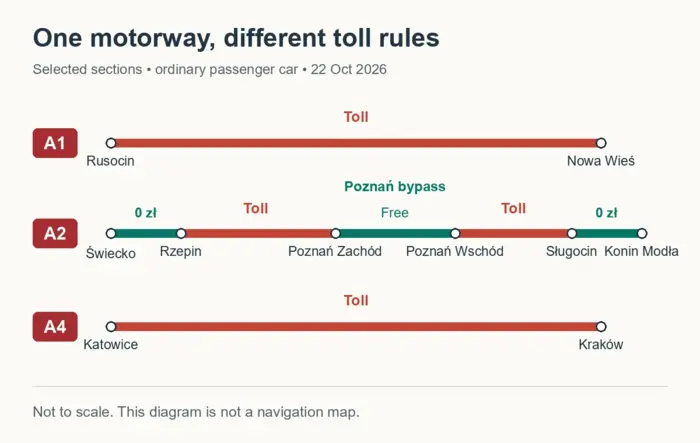
The road section matters more than the motorway number. The state-managed A2 Konin–Stryków and A4 Wrocław–Sośnica sections are free for light vehicles. Concession-operated sections remain chargeable, with an exception for the Poznań bypass on the A2. The distinction appears in GDDKiA’s list of motorway toll sections in Polish.
| Section | Ordinary car up to 3.5 t | Payment arrangement |
|---|---|---|
| A1 Rusocin–Nowa Wieś | Toll applies | Entry ticket and payment on exit, or active AmberGO |
| A2 Świecko–Konin | Tolls with exceptions | Toll booths; number-plate payment only at supported Poznań–Konin points |
| A2 Poznań Zachód–Poznań Wschód | Free | No toll ticket to buy for this bypass section |
| A4 Katowice–Kraków | Toll applies | Two toll plazas; card, cash or a supported automatic service |
| A2 Konin–Stryków / A4 Wrocław–Sośnica | Free | No road toll for a light vehicle |
How much do the A1, A2 and A4 cost in 2026?
Do not multiply a single booth charge by the length of an entire motorway. The A1 price depends on entry and exit points; the A2 concession uses different arrangements along its route; and the A4 Katowice–Kraków has two separate toll plazas. Budget for the actual outward and return route rather than a supposed fixed charge for reaching a city.
| Example journey | One way | What the price covers |
|---|---|---|
| A1 Rusocin–Nowa Wieś | 29.90 zł | Full section, category 1 |
| A2 Świecko–Konin Modła | 141 zł | Standard tariff, excluding videotolling promotions |
| A2 Świecko–Poznań Zachód | 59 zł | Standard tariff between the named junctions |
| A2 Poznań Wschód–Konin Modła | 82 zł | Standard tariff between the named junctions |
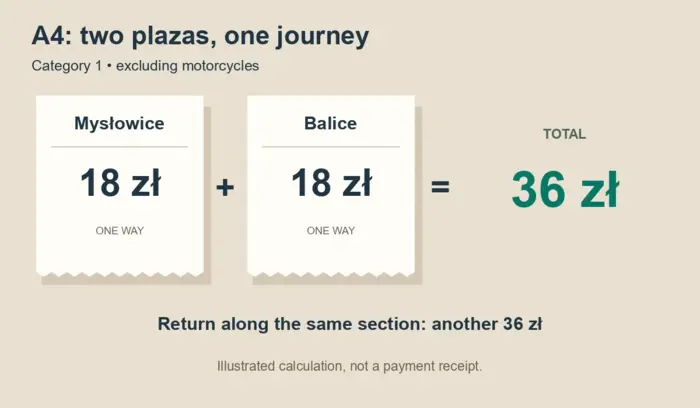
| A4 Katowice–Kraków | 36 zł | 18 zł at Mysłowice + 18 zł at Balice |
A1: keep your ticket or use an active AmberGO service
With traditional payment on AmberOne A1, take a ticket on entry and pay on exit. Without a valid ticket, the maximum charge for your vehicle category and exit point may apply. For a shorter journey than Rusocin–Nowa Wieś, select your actual junctions in the AmberOne toll calculator and rate table instead of budgeting for the full section.
A2: check the tariff and automatic-payment coverage separately
The Autostrada Wielkopolska tariff took effect on 11 September 2026. The examples above use its standard category 1 matrix. Separate videotolling rates are available on Poznań–Konin; do not apply them to every part of the route from Świecko. When choosing an app, compare the road toll with any service fee charged by the payment provider.
A4: 18 zł is not the price of the whole section
On the A4 Katowice–Kraków, the 18 zł charge applies at each of the two plazas: Mysłowice and Balice. The full one-way journey therefore costs 36 zł; returning along the same section adds another 36 zł. Rates effective from 1 April 2026 and accepted payment methods are listed by the A4 Katowice–Kraków operator.
How do you pay: bank card, cash or an app?
Paying by card or cash at a supported booth does not require an app account. Choose a lane according to its signs and have your payment method ready before reaching the window. In a ticket-based system, keep the entry ticket until the end of the charged section. The two A4 payments are not an entry-ticket system followed by a single payment on exit.
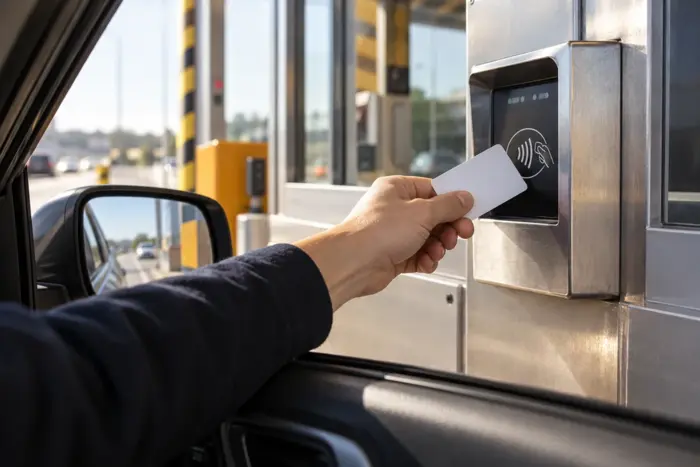
Videotolling uses number-plate recognition. Downloading an app alone is not enough: register the correct car, activate the relevant motorway service and check the payment method. On the A2, coverage is limited to supported points on Poznań–Konin, not every concession toll booth. An account holding your previous rental car does not automatically register the next one.
The A1’s AmberGO lane instructions in Polish say that if you collect an entry ticket, you must use a staffed booth on exit. If the barrier on an automatic lane does not open, use the help button. Do not reverse into the queue or follow another car through before the system has processed your vehicle.
Who needs e-TOLL: vehicle weight, buses and trailers
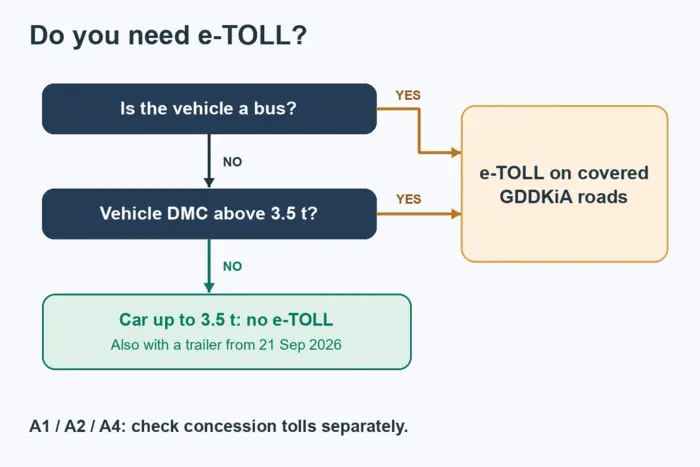
e-TOLL covers vehicles with a maximum permissible mass above 3.5 tonnes and buses regardless of that mass, on the GDDKiA roads included in its network. Classification depends on the documents, not the luggage carried or the vehicle’s weight on that particular day. The Polish term is DMC. Check the official e-TOLL explanation in Polish; an ordinary passenger car does not need the system merely because it enters a motorway.
Change effective from 21 September 2026: users of a vehicle with DMC up to 3.5 tonnes towing a trailer no longer have to settle that journey through e-TOLL. The KAS notice on the light-vehicle trailer exemption in Polish confirms the change. It does not remove concession tolls on the A1, A2 or A4, where a trailer may change the vehicle category and price.
How to pay motorway tolls in Poland with a rental car
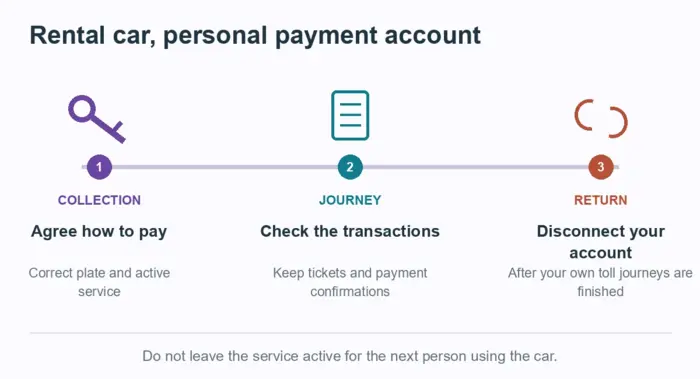
When collecting a car for a road trip from Warsaw, ask whether an automatic toll service is already active and who will settle each journey. Do not attach a second payment account without agreeing the arrangement. Neither the fact that the car is rented nor a tariff name proves that road tolls are included.
- Before departure: check junctions, vehicle category, registration number and the agreed payment method.
- During the journey: keep tickets and receipts, and check that payment has completed.
- At return: after your own toll journeys are finished, deactivate the service or remove the rental car from your personal account.
Otherwise, an active registration may charge your account for the car’s next user. The Autopay vehicle-handover instructions in Polish explain this mechanism. For a shorter trip, start with five day trips outside Warsaw with return-mileage planning, then check the charged sections on your chosen route.
Will the A4 Katowice–Kraków become free in 2027?
GDDKiA has announced that it will take over the section on 16 March 2027 and end tolls for passenger cars and motorcycles. That is a future date, not the rule in force in October 2026. Before travelling after the change, check the GDDKiA notice about the A4 concession ending in Polish and current traffic arrangements.