



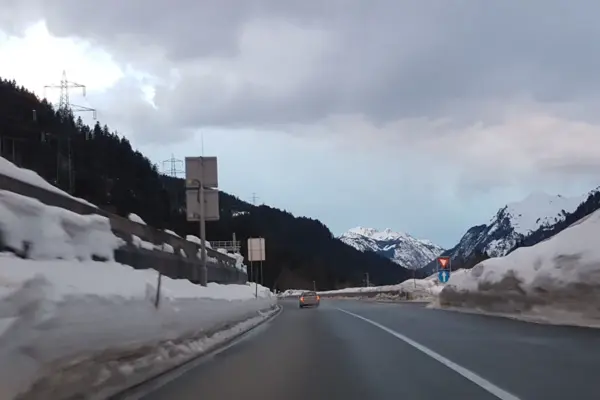
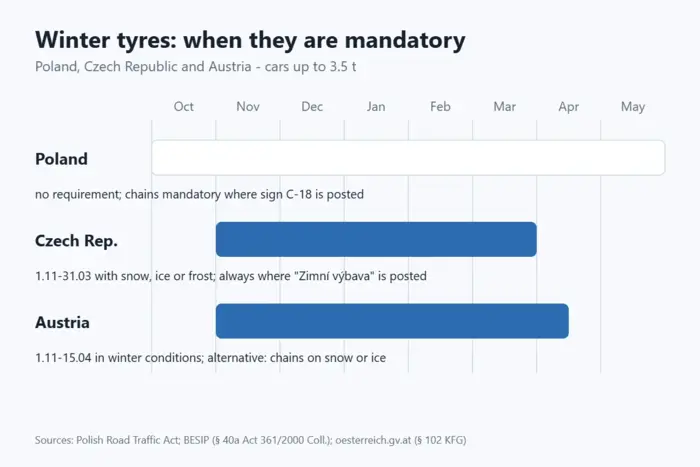
Winter tyres are not mandatory in Poland, but the rules change once you cross the border. In the Czech Republic, winter tyres are required from 1 November to 31 March whenever there is snow, ice or frost on the road, or it can be expected. In Austria, the requirement applies from 1 November to 15 April in winter conditions. In Poland, snow chains are mandatory where sign C-18 is posted and allowed only on a snow-covered road.
Winter tyres in Poland, the Czech Republic and Austria: comparison
Rules for cars up to 3.5 t for the 2026/2027 season:
| Country | When winter tyres are mandatory | Marking and tread | Snow chains |
|---|---|---|---|
| Poland | no general requirement | no separate requirements for winter tyres | mandatory at sign C-18; allowed only on a snow-covered road |
| Czech Republic | 1.11-31.03 with snow, ice or frost, or when they can be expected; always where the "Zimní výbava" sign is posted | M+S, M.S., M/S or MS; min. 4 mm | where a sign requires them |
| Austria | 1.11-15.04 in winter road conditions, on all wheels | M+S, M.S., M&S or the snowflake; min. 4 mm (radial) | instead of winter tyres only on a road fully covered with snow or ice |
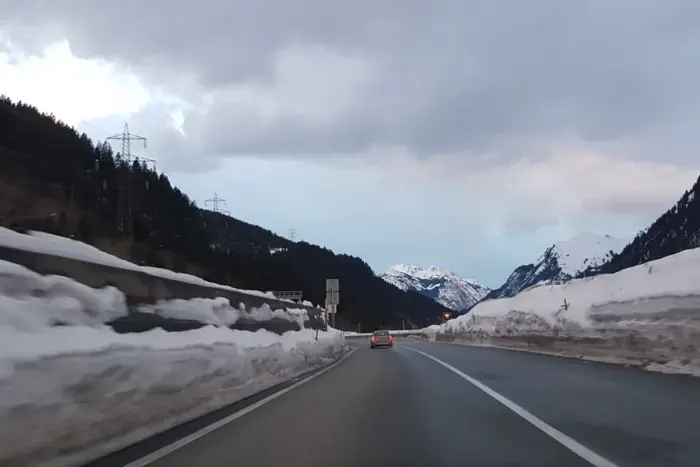
Winter tyres in Poland: required or recommended?
Polish law does not require winter tyres, and there is no legal date for changing tyres. Even so, below about 7°C summer tyres lose grip and braking distances on slippery roads grow noticeably. The European Consumer Centre notes that driving on summer tyres in winter can make an insurance claim harder (ECC Poland, in Polish).
Snow chains in Poland are mandatory only on sections marked with sign C-18, which requires anti-skid chains. You fit them on at least two drive wheels. Elsewhere you may fit them on a snow-covered road, but using chains on a road without snow is not allowed (Polish Road Traffic Act, art. 60(3), in Polish).
Winter tyres in the Czech Republic: dates and requirements
In the Czech Republic, winter tyres are mandatory from 1 November to 31 March if there is a continuous layer of snow, ice or frost on the road, or one can be expected during the journey. In practice, in the mountains such as the Krkonoše or the Šumava you need them for most of the winter. Municipalities can also post the "Zimní výbava" (winter equipment) sign - on such a section winter tyres are required regardless of the weather (BESIP, in Czech).
- Marking: M+S, M.S., M/S or MS is enough.
- Tread: at least 4 mm for passenger cars.
- Studded tyres: not allowed in the Czech Republic.
- Fine: about 60-100 euros for driving without the required winter tyres (ÖAMTC, in German, data from October 2026).
If you take Czech motorways, you also need an e-vignette - prices and where to buy it are covered in our guide to the Czech vignette.
Winter tyres in Austria: the rules
In Austria, cars up to 3.5 t must have winter tyres on all wheels from 1 November to 15 April when winter conditions apply: snow, slush or ice. Snow chains on at least two drive wheels are an alternative, but only when the road is fully covered with snow or ice. On a cleared motorway, chains do not replace winter tyres (oesterreich.gv.at).
- Marking: M+S, M.S., M&S or the snowflake symbol.
- Tread: at least 4 mm for radial tyres and 5 mm for cross-ply tyres.
- Responsibility: the driver is responsible for winter equipment, in a rental car too.
- Fine: about 100 euros, and up to 10,000 euros if you endanger other road users. The police can also stop a driver without winter tyres or chains from continuing the journey (ÖAMTC, in German, data from October 2026).
- After an accident: if you drive on summer tyres in winter conditions, you must show that the accident would have happened on winter tyres too. Otherwise you share at least part of the blame, and the third-party insurer that compensates the injured party may claim the money back from you.
How to recognise a winter tyre: M+S or the alpine symbol
Look for one of two markings on the tyre sidewall. M+S (mud and snow) is the manufacturer's own declaration that the tyre suits mud and snow - it does not involve a separate snow test. The alpine symbol, a snowflake inside a three-peak mountain (3PMSF), marks a tyre that has passed a snow performance test. M+S is enough in the Czech Republic and Austria, but for mountain routes a tyre with the alpine symbol is the better choice.
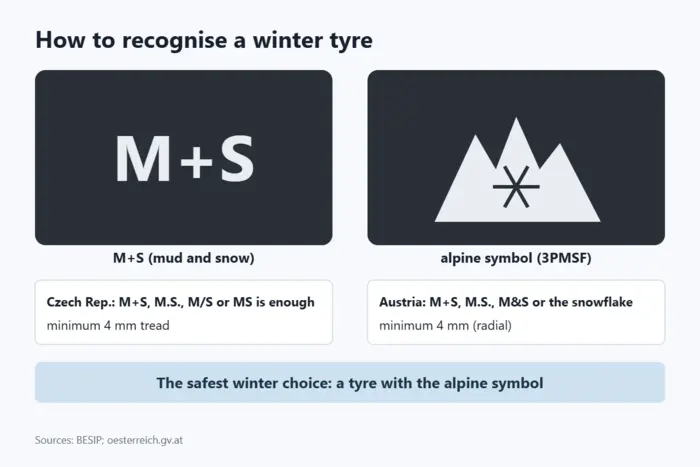
All-season tyres meet the requirements only if they carry one of these markings. Also check the tread depth across the whole width of the tyre - before a trip to the Czech Republic or Austria it should be at least 4 mm.
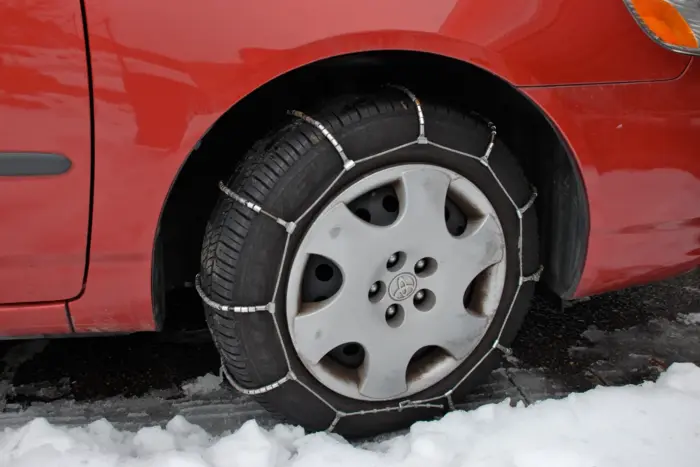
Snow chains: when and how to use them
- Fit them on the drive wheels - the front wheels on a front-wheel-drive car, the rear wheels on a rear-wheel-drive car. For 4x4 cars, check the owner's manual.
- Use them only on snow or ice - on dry asphalt they damage the road and the tyres, and in Poland it is against the rules.
- Practise fitting them before you go. On a mountain pass, in snow and in the dark, it takes much longer.
- Drive gently - with chains, keep your speed down and avoid hard braking.
- On mountain roads in the Czech Republic and Austria, a sign may require chains - then you must fit them whatever tyres you have.
A winter trip abroad in a rental car: checklist
- Permission to travel: at BLS, driving outside Poland is a paid option that requires written consent, and the terms are agreed individually - tell us your route before you book. Details are in the rental terms.
- Tyres: in the winter season BLS cars have winter tyres, and the seasonal tyre change is included in the price. Check the marking on the sidewall when you pick up the car.
- Snow chains: BLS does not provide snow chains. If your route crosses Alpine passes, buy or rent chains that match the tyre size - you will find the size on the tyre sidewall when you pick up the car.
- Road charges: the Czech Republic and Austria require vignettes on motorways - buy them before you cross the border. Austrian prices and rules are in our Austria vignette 2026 guide.
- Equipment: winter screenwash, an ice scraper, a snow brush and a charged phone.
For more on planning such a trip, see our guide to renting a car for a trip abroad. For a winter drive to the Alps or the Czech mountains, you can pick up a car in Warsaw - see car hire in Warsaw - or browse our rental cars in Kraków, close to the Czech border. If you are staying in Poland, see where to go in Poland in winter.
FAQ
Are winter tyres mandatory in Poland?
No, Poland has no winter tyre requirement. They are recommended, though, once temperatures drop below about 7°C.
When are winter tyres mandatory in the Czech Republic?
From 1 November to 31 March, when there is snow, ice or frost on the road or it can be expected. Where the "Zimní výbava" sign is posted, they are always required.
Until when do you need winter tyres in Austria?
Until 15 April. The requirement starts on 1 November and applies when driving in winter conditions.
Are all-season tyres allowed in the Czech Republic and Austria?
Yes, if they carry the M+S marking or the alpine snowflake symbol and have at least 4 mm of tread.
What is the fine for driving without winter tyres in Austria and the Czech Republic?
According to ÖAMTC, about 100 euros in Austria, and up to 10,000 euros if others are endangered. In the Czech Republic, about 60-100 euros.
Can I drive in Austria on summer tyres with snow chains?
Only when the road is fully covered with snow or ice and the chains are fitted on at least two drive wheels. On a cleared road in winter conditions, you need winter tyres.