



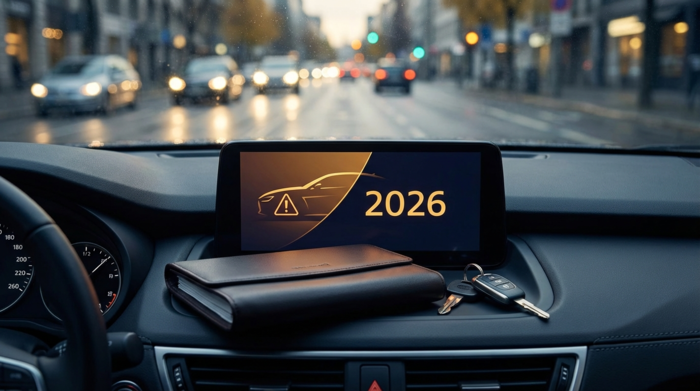
The new fine tariff for 2026 introduces key changes that every driver in Poland should know. Although many fine rates remain at previous year's levels, 2026 brings significant tightening, especially regarding driving license suspension for speeding outside built-up areas and increased penalties for the lack of OC insurance. Understanding these regulations is fundamental for safety and avoiding high fines. At BLS Rent Car, we ensure our clients are aware of their rights and obligations, which is why we have prepared a comprehensive guide to the current regulations. Visit BLS and learn how the new regulations affect your driving and responsibilities.
Uncertainty regarding current traffic regulations and rising fine rates can be a source of anxiety for many drivers. Our article aims to clarify any doubts by presenting the current fine tariff and discussing in detail the most important changes in regulations that have entered or will enter into force in 2026. You will learn about the new fine rates, how the fine tariff and penalty points system works, and what the new recidivism rule means.
Key Information
- New Speed Rules: As of March 3, 2026, exceeding the speed limit by over 50 km/h outside built-up areas on single-carriageway two-way roads will result in a 3-month driving license suspension.
- Increased Penalties for Lack of OC Insurance: As of January 1, 2026, penalties for the lack of mandatory OC insurance have increased, reaching up to PLN 9610 for passenger cars.
- Changes in Penalty Points: Penalty points expire one year after the fine is paid, and re-education courses (reducing 6 points) are available once every six months, with restrictions for the most serious offenses starting in June 2026.
- Stricter Penalties for Serious Offenses: The maximum fine from the police is PLN 5000, and a court fine can be up to PLN 30,000. New penalties have been introduced for "grossly dangerous driving," illegal races, and drifting.
- Recidivism = Double Fine: For repeating the same serious offense within two years, drivers face double the fine rate.
- Vehicle Confiscation: Regulations regarding vehicle confiscation for drunk drivers (from 1.5 permille) have been in effect since March 2024, with clarification of rules in 2026.
- Responsibility at BLS: BLS Rent Car clients are responsible for all fines and administrative fees related to traffic violations in the rented vehicle.
What Actually Changed in the Fine Tariff in 2026?
Although one often hears about the "new fine tariff 2026" as a one-time, comprehensive reform, the reality is more complex. Many significant increases and tightenings in the Code of Misdemeanors and the Road Traffic Act occurred in 2022-2025. The year 2026 focuses more on refining existing regulations and introducing further specific restrictions aimed at improving road safety.
The most important changes that have entered or will enter into force in 2026 are:
- January 2026: Increase in penalties for the lack of mandatory OC insurance, directly resulting from the increase in the minimum wage.
- March 3, 2026: A key change that extends the automatic 3-month driving license suspension for exceeding the speed limit by over 50 km/h. Previously, this tightening mainly applied to built-up areas; now it also covers single-carriageway two-way roads outside built-up areas.
- March 30, 2026: Introduction of new restrictions for "grossly dangerous driving," covering behaviors such as drifting or abrupt, unjustified changes in direction of travel, which can result in a 3-month driving license suspension.
- June 2026: Limitations on the possibility of reducing penalty points through re-education courses. The most serious offenses, such as running a red light or driving under the influence of alcohol, will no longer qualify for reduction.
- Clarification of Confiscation Regulations: Although vehicle confiscation for drunk drivers has been in effect since March 2024, the rules for its adjudication have been clarified in 2026, particularly regarding vehicle ownership and alternative monetary compensation.
Drivers should be aware that the current fine tariff is an evolution of regulations, not a one-time revolution. Regularly checking current regulations is crucial to avoid unpleasant surprises.
Speeding: New Rules for License Suspension and Fine Rates
Exceeding the speed limit remains one of the most common causes of accidents and is severely punished. In 2026, the territorial scope in which significant speeding leads to immediate license suspension has been expanded. These are significant new fine rates.
Driving License Suspension: As of March 3, 2026, exceeding the speed limit by more than 50 km/h on a single-carriageway two-way road outside a built-up area results in a 3-month driving license suspension. This expands the existing rules, which primarily applied in built-up areas.
Below is the new fine tariff table for speeding in 2026:
| Speeding | Fine (without recidivism) | Penalty Points |
|---|---|---|
| Up to 10 km/h | PLN 50 | 1 point |
| 11-15 km/h | PLN 100 | 2 points |
| 16-20 km/h | PLN 200 | 3 points |
| 21-25 km/h | PLN 300 | 5 points |
| 26-30 km/h | PLN 400 | 7 points |
| 31-40 km/h | PLN 800 (recidivism PLN 1600) | 9 points |
| 41-50 km/h | PLN 1000 (recidivism PLN 2000) | 11 points |
| 51-60 km/h | PLN 1500 (recidivism PLN 3000) | 13 points |
| 61-70 km/h | PLN 2000 (recidivism PLN 4000) | 14 points |
| Over 70 km/h | PLN 2500 (recidivism PLN 5000) | 15 points |
Always adjust your speed to the road conditions and the applicable limits. Use cruise control if your vehicle is equipped with it to maintain a constant, safe speed. It is important to understand that the new regulations from March 2026 expand the risk of losing your license to single-carriageway two-way roads outside cities, requiring particular caution. When choosing a car at BLS, pay attention to models equipped with driver assistance systems, such as adaptive cruise control, which will help you maintain a safe speed.
Penalty Points 2026: Limits, Changes in Expiration, and Re-education Courses
The penalty points system is designed to discipline drivers. In 2026, changes have been introduced to the rules for their expiration and the possibility of reducing them through courses. Therefore, the fine tariff and penalty points remain a consistently important issue.
Penalty Point Limits:
- 20 points for drivers holding a license for less than one year.
- 24 points for other drivers. Exceeding the limit results in driving license suspension.
Expiration of Points: Penalty points expire one year after the date the fine is paid. This rule (introduced on September 17, 2023) replaced the previous two-year period.
Re-education Courses: As of September 17, 2023, the possibility of participating in re-education courses has returned. They allow for a reduction of 6 penalty points. Courses can be used a maximum of once every six months, provided the point limit is not exceeded.
Restrictions from June 2026: From June 2026, it will no longer be possible to reduce penalty points for the most serious offenses, such as running a red light, driving under the influence of alcohol, or drastic speeding.
Regularly check your penalty points balance online. If you are approaching the limit, consider participating in a re-education course if your offenses qualify for reduction. Remember the one-year period for points expiration from the date of fine payment and the upcoming limitations for re-education courses for serious offenses. BLS encourages responsible driving to avoid penalty points, which can affect the ability to rent vehicles in the future.
Pedestrians, Overtaking, and Other Common Offenses: Current Penalties
Road safety is not just about speed. Regulations also severely punish offenses against pedestrians, improper overtaking, using a phone, or not wearing seatbelts, which significantly impact accident risk. Thus, the fine price list contains many items.
Selected Fine Rates for Other Offenses (Fine Tariff 2026):
| Offense | Fine (without recidivism) | Penalty Points |
|---|---|---|
| Failure to yield to a pedestrian at a crosswalk | PLN 1500 (recidivism PLN 3000) | 15 points |
| Overtaking at or before a pedestrian crossing | PLN 1500 (recidivism PLN 3000) | 15 points |
| Overtaking a vehicle that has yielded to a pedestrian | PLN 1500 (recidivism PLN 3000) | 15 points |
| Holding a phone while driving | PLN 500 | 12 points |
| Not wearing a seatbelt (driver) | PLN 100 | 5 points |
| Transporting a child without a car seat or improperly | PLN 300 | 5 points |
| Not stopping at a STOP sign | PLN 300 | 8 points |
| Violation of overtaking prohibition | PLN 1000 (recidivism PLN 2000) | 15 points |
| Not maintaining safe distance ("tailgating") | PLN 300-500 | 5 points |
| Violation of the prohibition of using a life-saving lane | PLN 500-2500 | 8 points |
| Driving without required lights from dusk till dawn | PLN 300 | 6 points |
| Driving without required lights from dawn till dusk | PLN 100 | 2 points |
| Improper crossing of railway tracks | PLN 2000 (recidivism PLN 4000) | 15 points |
Always exercise special caution near pedestrian crossings. Put your phone away before starting to drive and ensure all passengers have their seatbelts fastened. Many "minor" offenses, especially those concerning pedestrians, carry very high fines and the maximum number of penalty points. All BLS vehicles are equipped with functional seatbelts and child seat mounting systems. Ensure your safety and that of your passengers by using them in accordance with regulations.
Vehicle Confiscation and Severe Penalties for Drunk Drivers
Driving under the influence of alcohol or intoxicating substances is one of the most serious traffic offenses, and the regulations from 2026 (clarifying those from 2024) introduce mandatory vehicle confiscation or its equivalent value.
Mandatory Vehicle Confiscation: This is imposed when a driver has at least 1.5 permille of alcohol in their blood (or 0.75 mg/dm3 in exhaled air), caused an accident with at least 0.5 permille, or committed recidivism (drove under the influence of alcohol again within 24 months).
Alternative Monetary Compensation: If the vehicle is not solely owned by the offender (e.g., rented, borrowed, leased) or its confiscation is impossible (e.g., sold, destroyed), the court imposes a sum of money from PLN 5000 to PLN 500,000 to the State Treasury for the Fund for Victims and Post-penitentiary Assistance.
Prison Sentences: Simply driving a vehicle while intoxicated carries a prison sentence of up to 3 years. In cases where an accident causing serious bodily harm is caused, the penalty is from 3 to 16 years of imprisonment.
Lifelong Driving Ban: This can be imposed if a driver fails to comply with a court driving ban and causes an accident while intoxicated, under the influence of intoxicating substances, flees the scene, or consumes alcohol after an accident.
Never get behind the wheel after consuming alcohol. Always plan alternative transportation if you intend to drink. Even if you are not the owner of the vehicle (e.g., you rent it), you may be liable for a high monetary compensation equivalent to the vehicle's value. BLS Rent Car strongly condemns drunk driving. In case of violations, the client bears full legal and financial responsibility, in accordance with Polish law and the rental agreement terms.
Fines for Lack of OC Insurance in 2026: New Rates and Financial Risk
Mandatory OC insurance is a fundamental requirement for every registered vehicle in Poland. In 2026, due to the increase in the minimum wage, penalties for its absence have significantly increased.
Increase in Penalties: As of January 1, 2026, penalties for the lack of OC insurance are higher because their amount is linked to the minimum wage.
Fine Rates for Passenger Cars (as of January 1, 2026):
- Lack of OC up to 3 days: PLN 1920
- Lack of OC from 4 to 14 days: PLN 4800
- Lack of OC over 14 days: PLN 9610
Fine Rates for Motorcycles: From PLN 310 to PLN 1560.
Fine Rates for Heavy Goods Vehicles: From PLN 2880 to PLN 14,420.
Fines are imposed by the Motor Insurance Guarantee Fund (UFG), which has effective tools for detecting uninsured vehicles. A fine can be imposed even on the owner of a vehicle that is not in use and is parked in a garage, if it is registered and does not have valid OC. Always ensure that your vehicle has valid OC insurance. Remember that the obligation to have OC insurance applies to every registered vehicle, regardless of whether it is used. All BLS Rent Car vehicles have current and full insurance. Clients renting our cars do not have to worry about this aspect but should take care of their own vehicles.
Recidivism: Double Penalties for Repeat Offenses
The recidivism rule is intended to more severely punish drivers who repeatedly break the law. In 2026, similar to previous years, repeating the same serious offense within two years results in doubling the fine.
Definition of Recidivism: If within two years, a driver is caught committing the same offense for which they have previously received a fine, they will be fined double the rate. Stricter regulations for punishing recidivism have been in effect since September 2022.
Examples of Offenses Covered by Recidivism:
- Speeding by more than 30 km/h.
- Failure to yield to a pedestrian.
- Overtaking at or immediately before a pedestrian crossing.
- Overtaking a vehicle that has stopped to yield to a pedestrian.
- Violation of overtaking prohibition (e.g., at an intersection, on an incline, on a curve).
- Violation of the prohibition of driving around lowered railway barriers.
After receiving a fine, treat it as a warning. Carefully analyze your driving habits to avoid repeating the offense and facing a double penalty. The recidivism system aims to foster safe behaviors in the long term, and repeated mistakes are very costly. BLS Rent Car encourages continuous improvement of driving skills and adherence to regulations to avoid the costly consequences of recidivism.
Received a Fine in a BLS Rental Car? What Next?
Clients renting vehicles from BLS Rent Car are fully responsible for all traffic violations committed during the rental period. BLS has established procedures for handling cases of fines for rented vehicles.
Client Responsibility: In accordance with the rental terms, the client is responsible for all fines, parking fees, toll fees (e.g., for toll highways, clean transport zones), and other penalties resulting from violations during the rental period.
BLS Procedure:
- Upon receiving notification of a fine (e.g., from a speed camera, municipal police), BLS identifies the client who rented the vehicle during that period.
- BLS provides the driver's details to the relevant authorities (e.g., police, municipal police) upon their request, in accordance with applicable law.
- The client will be informed of the fine and will be obliged to settle it directly with the issuing authority.
BLS fees: BLS charges no fee for passing on the driver's details in a speeding case. A 200 zł fee applies to cases that need correspondence with the authorities, for example after a collision or an unpaid motorway toll. The whole procedure and its deadlines are explained in our guide to a speed camera fine in a rental car.
Driving License Suspension During Rental: In the event of driving license suspension during the rental, the client is obliged to immediately cease driving and inform BLS. Further driving without a license is a criminal offense and a breach of the rental agreement.
Always observe traffic regulations, regardless of whether you are driving your own car or a rented vehicle. A fine received in a rental car is the driver's problem, and the rental company merely acts as an intermediary in transferring data. For questions regarding fines or rental terms, please contact BLS Rent Car customer service. We are here to help and clarify any doubts.
Summary
The new fine tariff for 2026 is another step towards increasing safety on Polish roads. Tightening regulations, such as expanding the possibility of losing a driving license for speeding outside built-up areas or higher penalties for the lack of OC insurance, are intended to encourage drivers to be more cautious and responsible. Remember that current knowledge and adherence to regulations are not only a way to avoid high fines and penalty points but, above all, a guarantee of safety for you and other road users.
For those who value flexibility and freedom of travel without the obligations associated with owning their own car, BLS Rent Car offers comfortable and safe vehicles. By choosing our services, you can rely on transparent terms and always functional vehicles, allowing you to focus solely on safe driving. Take advantage of our solutions, such as long-term car rental, and see how convenient responsible travel can be. We are proud of our mission to make every journey enjoyable and safe.
FAQ - Frequently Asked Questions about the Fine Tariff in 2026
- 1. Have all fines increased in 2026?
No, many fine rates have remained at the 2022 level. However, in 2026, new rules and tightenings have been introduced regarding, among others, driving license suspension for speeding outside built-up areas, penalties for lack of OC have been increased, and vehicle confiscation regulations have been clarified. - 2. Since when does speeding outside built-up areas result in driving license suspension?
As of March 3, 2026, exceeding the speed limit by over 50 km/h on a single-carriageway two-way road outside a built-up area results in an automatic 3-month driving license suspension. - 3. How much time do I have to pay a fine?
A credited fine (mandat kredytowany) must be paid within 7 days of accepting it. This also applies to a speed camera fine, which CANARD issues as a credited fine. A fine issued in absentia (mandat zaoczny), for example one left under the windscreen wiper, has a 14-day payment deadline. - 4. Do penalty points expire after one year or two years?
Currently, penalty points expire one year after the date the fine is paid. - 5. How much is the fine for lack of OC insurance in 2026?
As of January 1, 2026, the maximum fine for the lack of OC for a passenger car for more than 14 days is PLN 9610. These rates depend on the vehicle type and the duration of the insurance gap.