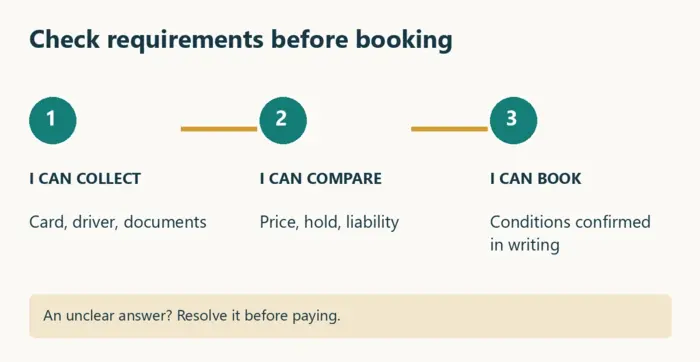




Compare no-deposit car rental on three separate measures: what you pay, what funds are held temporarily and what liability the agreement leaves with you. Then check the card requirements, cover, mileage, fuel and collection and return arrangements. Removing a standard security deposit does not establish that every card hold or possible settlement disappears.
Compare the same dates, times, vehicle class and route; an attractive offer label does not replace the booking conditions.
No-deposit car rental: seven conditions to compare
Keep a separate column of notes for each offer. Rather than recording only “yes” or “no”, write down an amount, allowance or condition. Ask for any missing answer before you pay.
| Compare | Ask the provider | Record the answer |
|---|---|---|
| 1. Security | Does any hold remain, including a traffic-fine hold? | Amount, currency, purpose and release procedure |
| 2. Liability | What excess and exclusions apply to this agreement? | Damage and theft limits, plus exceptions |
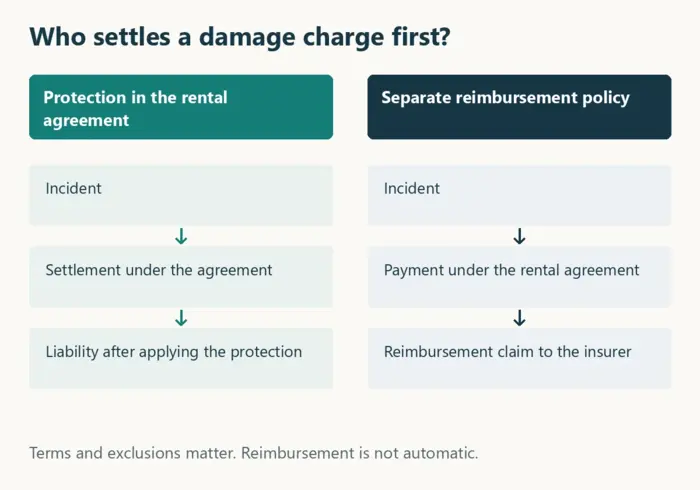
| 3. Cover | Does it change the rental contract or reimburse you later? | Who handles a claim and who pays first |
| 4. Card | Which card and whose name are required at collection? | Debit/credit, cardholder and available limit |
| 5. Mileage | How many kilometres does the whole booking include? | Allowance, calculation method and excess-mileage terms |
| 6. Fuel | What fuel level must the car have at collection and return? | Required level and how it is documented |
| 7. Handover | Where, when and under what procedure do you hand over the car? | Times, location, late-return procedure and settlement |
If security and liability still seem interchangeable, start with the explanation of deposits, preauthorisation and excess. Here, use those distinctions to compare offers rather than adding the terms together as separate charges.
Does no deposit mean car rental without a credit card?
The label alone does not establish that. Confirm the card used to pay for the booking separately from the card required when the vehicle is handed over. Ask about debit cards, a physical card, the main driver’s name and the available funds required. Successful online payment does not settle every collection requirement.
The European Consumer Centre’s guide to rental cards and deposits recommends checking your card type before renting. If you plan to use a different card or a second driver’s card, obtain the provider’s agreement before travelling rather than negotiating at the counter.
BLS accepts cashless payment by VISA, Mastercard or American Express. If you want to use a debit card, say so when booking and ask for confirmation.
Rental-company protection or reimbursement from an insurer?
Check which organisation handles the damage settlement. Protection agreed with the rental company may change your liability under its contract. A separate reimbursement policy may instead require you to pay a charge first and then submit a claim for repayment. Do not treat these mechanisms as interchangeable or assume a broker’s policy removes collection requirements.
Ask for the terms covering glass, tyres, the underbody, keys, theft and incident reporting. These are questions for the particular product, not a list of automatically insured risks. Your Europe explains rental-car insurance cover: check which damage the contract covers and which driver obligations remain.
Compare the booking price separately from refundable security
First match the period, location, class, mileage and necessary equipment. Record the total rental price, with security on a separate line. Where cover differs, note the difference in liability; a smaller hold alone does not make an offer better.
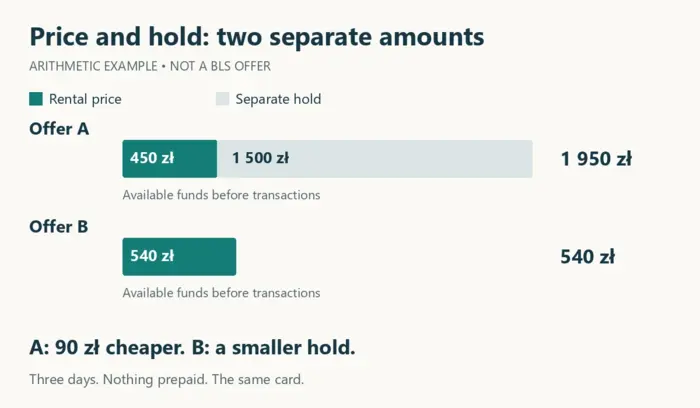
Arithmetic example, not a BLS offer: assume three rental days, the same class and comparable other conditions. Offer A costs 450 zł and requires a 1,500 zł hold. Offer B costs 540 zł with no hold. Nothing has been prepaid; in this example, both payment and security use the available funds or limit on the same card.
| Item | Offer A | Offer B |
|---|---|---|
| Three-day rental price | 450 zł | 540 zł |
| Separate card hold | 1,500 zł | 0 zł |
| Available funds before the transactions | 1,950 zł | 540 zł |
A is 90 zł cheaper but needs more available funds. B leaves more money accessible but is not cheaper for that reason. Fuel and parking are excluded from the example. The guide to rental costs for different booking lengths explains other budget components.
For a short trip, compare times as well as calendar dates. The same weekend can produce a different chargeable period; use the weekend guide to rental days and mileage to plan it. Do not count amounts already paid a second time.
At BLS, the 69 zł prepayment is not refunded if you cancel, and returning the car 2 hours or more late counts as another rental day.
How should you compare BLS Base and Prime?
If you are considering no-deposit car rental in Warsaw, compare the actual booking options rather than only the wording beside a vehicle. BLS Base includes up to 250 km per day and a standard deposit. Prime provides unlimited mileage, and the deposit for cars included in the offer is currently 0 zł. You still pay your own traffic fines.
Read the BLS tariff comparison in Polish. Prime requires you to be at least 25 with a licence held for 3 years. Liability for an accident, theft or total loss is 0 zł on this tariff if you follow the contract. On Base, your liability is up to the deposit for an accident and up to 10% of the car’s value for theft or total loss. You can check Prime availability and the deposit for a specific car and dates before booking.
On the BLS Warsaw offer without a standard deposit, open a vehicle and check the selected tariff before comparing its price. Read the liability and cover conditions for that same booking.
A reduced deposit does not replace a condition report
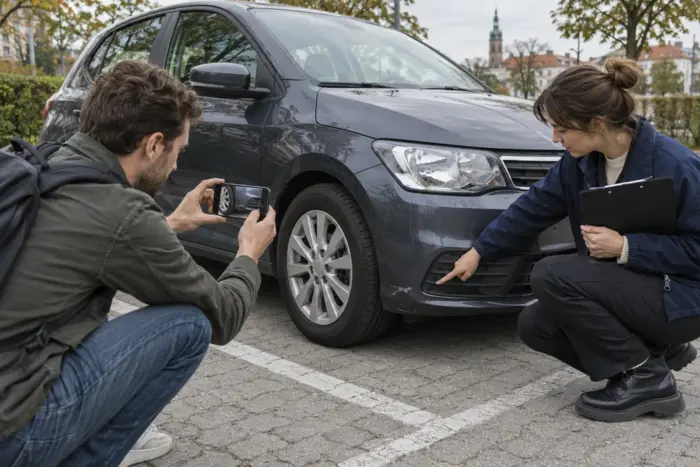
At collection, inspect the bodywork, wheels, glass and interior together. Record existing damage, mileage, fuel and equipment. Take overall photographs and close-ups of the relevant areas. Report discrepancies before driving away and keep a copy of the condition report.
At return, document the condition, odometer and fuel again. Confirm the key handover and how you will receive the settlement. Agree an unattended return procedure in advance if no employee will be present. A photograph of keys in a drop box is not a substitute for the documents.
A message that makes offers comparable before you pay
Send every provider the same requirements. Ask for a written answer and keep it with the booking terms. Do not send a full card number, CVV or login credentials.
Please quote for [dates and times], collection [location], return [location], class [class], planned mileage [km] and route [countries]. Please state the total rental price, every card hold and its purpose, card requirements, liability and cover exclusions, plus fuel and return rules. Do these conditions apply to the specific tariff selected?
Choose an offer you can actually collect, fund and use on your route. Only then compare price and the convenience of a smaller hold between those eligible options.