



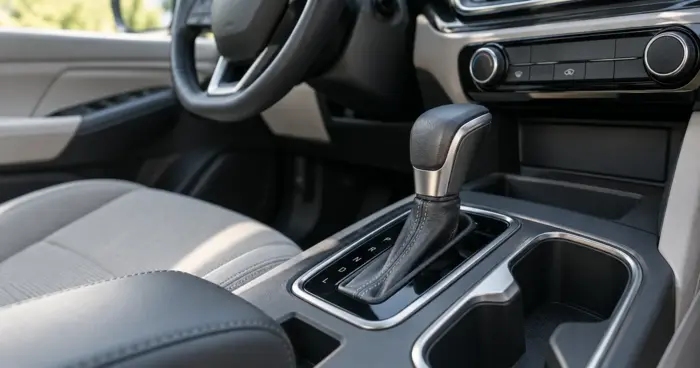
How to drive an automatic car: use your right foot for the brake and accelerator in normal driving, select D to move forwards and R to reverse, and stop completely before changing direction. When parking, use P and the parking brake as specified for the vehicle. Rest your left foot on the footrest — there is no clutch pedal to press.
This guide is for a licensed driver switching from a manual or collecting an unfamiliar rental car. It does not replace driving lessons or the vehicle’s handbook. Before setting off, ask for a demonstration of the selector, parking brake and dashboard indicators. Make your first manoeuvres in a safe place where driving is permitted.
Automatic car gear letters: what do P, R, N and D mean?
The letters identify the direction of travel or transmission state, rather than a sequence of gears you need to shift through manually. The selector may be a lever, rotary dial or buttons. Check the dashboard after selecting a mode: moving the control alone does not confirm that the selection has been accepted.
| Mode | Meaning | Remember |
|---|---|---|
| P — Park | Parking position with a transmission lock. | Select only when fully stopped. It does not replace the parking brake. |
| R — Reverse | Backwards travel. | Stop and hold the brake before changing from D. |
| N — Neutral | Drive is not transmitted to the wheels. | It will not prevent rolling and is not a mode for coasting downhill. |
| D — Drive | Normal forwards travel. | The transmission selects the ratio; the driver still controls speed and braking. |
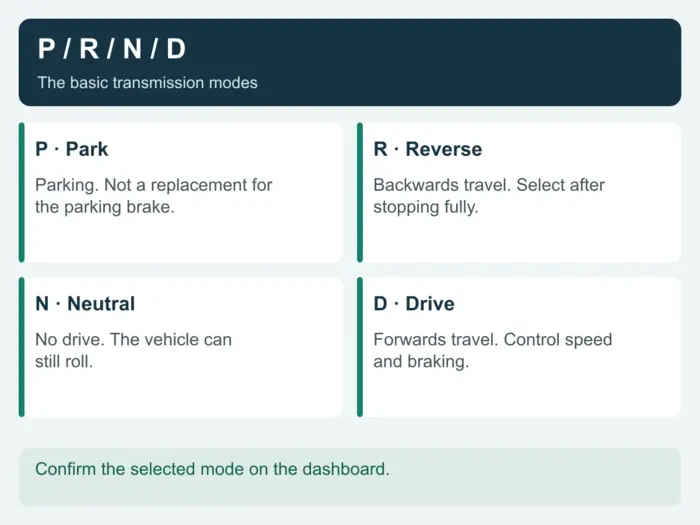
The basic PRND functions and direction-change warnings are explained in Hyundai’s automatic transmission instructions. Check the handbook for your own vehicle for its control layout and operating procedure.
How to drive an automatic car: pedals and moving off
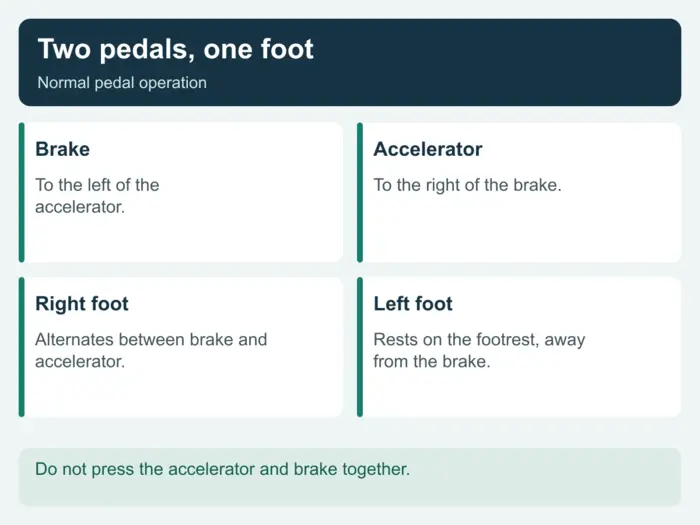
A typical automatic has no clutch pedal: the brake is to the left of the accelerator, and the accelerator is on the right. Before starting, adjust the seat so you can press the brake firmly, set the mirrors and fasten your seat belt. Check that the floor mat and loose objects cannot obstruct either pedal.
For normal driving, move your right foot between the accelerator and brake; do not press both together. Keep your left foot on the footrest, away from the brake. This approach is also described in the RAC’s guide to driving an automatic. If you instinctively reach for a clutch, get comfortable with the pedal layout before joining busy traffic.
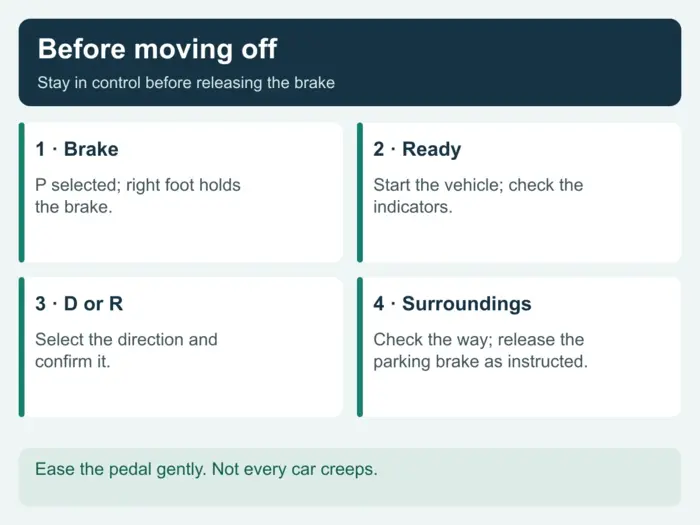
- Check that P is selected and press the brake firmly with your right foot.
- Start the vehicle using its specified procedure. In a hybrid, check the readiness indicator, such as READY, rather than relying on engine noise.
- Keep the brake pressed, select D or R and confirm the mode on the dashboard.
- Check around the car, including mirrors and blind spots. Release the parking brake following the vehicle’s procedure.
- Gradually ease the brake, remaining ready to stop. When the way is clear, apply gentle accelerator pressure if needed.
Do not assume every car will creep when you release the brake. Creep behaviour, Auto Hold and powertrain settings vary. If the car does not move, avoid suddenly pressing harder on the accelerator: check the selected mode, parking brake and dashboard messages.
Reversing and manoeuvring: stop fully between D and R
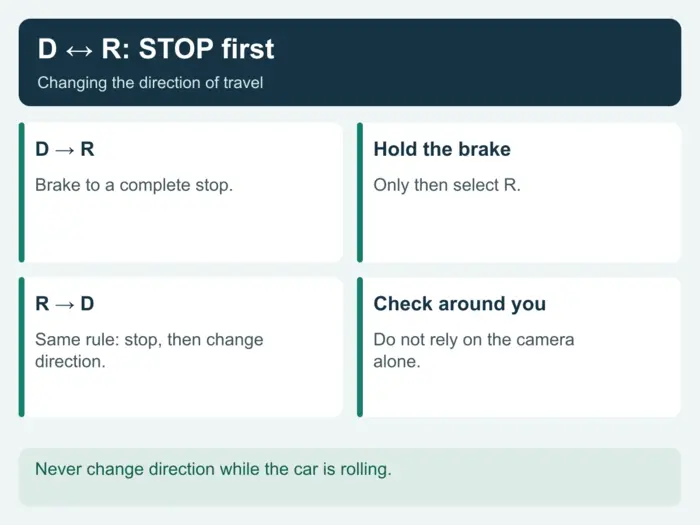
To change direction, stop the car completely with the brake before selecting D or R. Do not change direction while the vehicle is still rolling. Manoeuvre slowly in confined spaces, keeping your right foot ready to brake. Cameras and parking sensors assist you but do not replace checking the surroundings.
If you become unsure of the car’s position, stop and reassess. Do not try to correct a mistake by accelerating harder. Our separate guide to parallel parking in Poland covers positioning by the kerb; the priority here is deliberate control of direction and speed.
Driving an automatic in traffic, at lights and on hills
At a brief traffic-light stop, hold the vehicle with the footbrake; do not select P as a reflex every time you stop. If the car has Auto Hold, use it only after understanding the function and confirming that it is actively holding the vehicle. Auto Hold is not the same as the parking brake.
Check the model’s Auto Hold instructions before manoeuvring. For example, Hyundai’s instructions for this Auto Hold system specify deactivating it before reversing and parking. Do not assume the settings and operating rules are identical in another car.
Do not hold a car stationary on an uphill slope with the accelerator. Use the brake and the model’s hill-start procedure: D alone does not guarantee protection against rollback. Do not select N to coast downhill. On a long descent, follow the handbook’s speed-control guidance instead of experimenting with unfamiliar modes. Hyundai’s good driving practices warn against selecting N while moving and changing direction before stopping.
How do you park an automatic and switch it off?
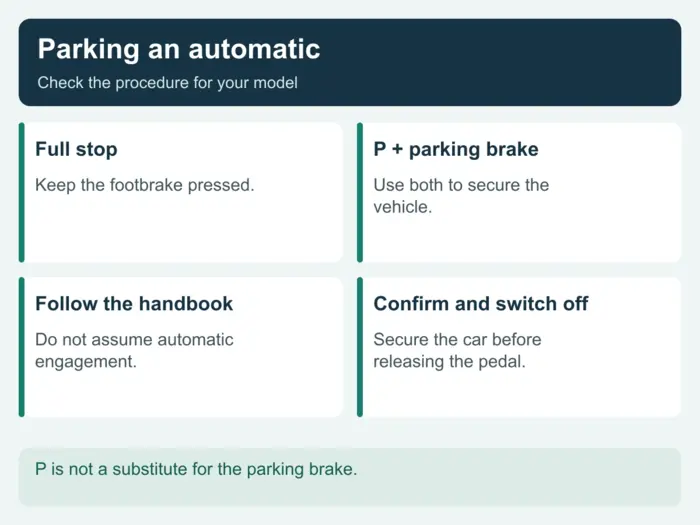
Stop completely and keep the footbrake pressed. Secure the car with P and the parking brake in the order specified for the model, checking their dashboard indications. Then switch off the powertrain as instructed, releasing the pedal only after the vehicle has been properly secured.
Do not assume that P or the parking brake will engage automatically. Never leave the car parked in N. If you do not know how to apply the electronic parking brake, ask for a demonstration before travelling, rather than discovering the control for the first time on a steep car park ramp.
What should you check when collecting an automatic rental?
When choosing a rental car in Warsaw, confirm the transmission for the car you are booking. Do not rely solely on an interior photo of a similar model. Arrange your collection point in advance using our comparison of airport, office and delivered car collection.
- Where are P and the parking brake, and where is the selected direction displayed?
- How do you confirm readiness to drive and switch the powertrain off correctly?
- Does the car creep when the brake is released? How do Auto Hold and hill-start assistance work?
- What do the additional modes mean, and what are the parking and downhill instructions?
If the selector will not move out of P, do not force it or bypass its lock. Secure the car, read the messages and contact the rental team. Do not continue driving with a brake or powertrain warning without getting assistance.
Questions before your first automatic drive
Do all automatic transmissions work alike?
No. Conventional automatics, dual-clutch transmissions and CVTs differ in design and response. Similar direction labels do not mean identical operating procedures; an electric vehicle can have a similar selector without a conventional multi-speed gearbox.
What do S, M, B and the plus and minus signs mean?
S often identifies a sport setting, M and +/− may allow manual gear selection, and B may increase powertrain braking. These labels are not universal. Read the model’s instructions before using them; you do not need to learn unfamiliar modes by trial and error just to move off normally.
Is a quiet hybrid switched off?
Not necessarily. Use the readiness indicator rather than engine noise alone. The meaning of READY is explained in Hyundai’s hybrid-system instructions. Complete the parking and shutdown procedure before leaving the vehicle.