



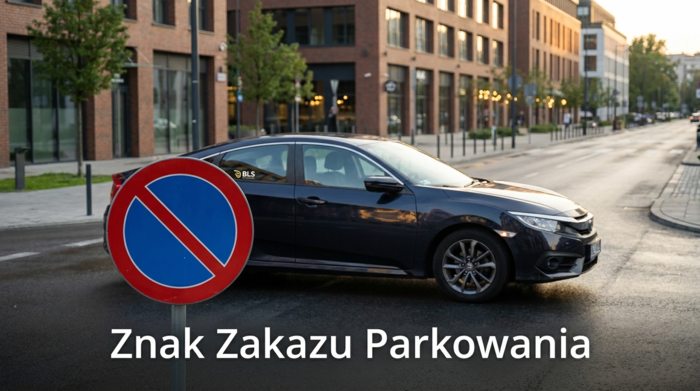
In the maze of road regulations, correctly understanding the no parking sign is crucial for every driver, especially for those using rented vehicles. In Poland, as in many countries, interpreting vertical and horizontal markings can be a challenge. Regardless of whether you're traveling for business or going on vacation, knowing the parking rules will save you from unpleasant surprises, such as fines or vehicle towing. At BLS, we know how important a sense of security and peace of mind is during every journey. Therefore, to ensure maximum comfort and stress-free driving, we have prepared this comprehensive guide. Familiarize yourself with it before you set off, using our general car rental offer or planning a trip, e.g., with car rental in Warsaw.
Why Understanding Parking Signs is Crucial for Your Rental?
Correct parking is not just a matter of complying with regulations, but also of ensuring a hassle-free journey. For car renters, this is particularly important, as any consequences of improper parking, such as fines or towing costs, are passed on to the renter.
Avoid Fines and Additional Fees
Ignorance of the law does not exempt from responsibility. Fines for incorrect parking can be costly, and in the case of a rented vehicle, administrative fees charged by the rental company for handling the case are often added to the fine amount. Understanding what a given no parking sign means will help you avoid unplanned expenses.
Safety and Traffic Flow
Road signs are not placed without reason. Their purpose is to ensure the safety of all road users - drivers, pedestrians, and cyclists, as well as to maintain smooth traffic flow. By parking in permitted areas, you contribute to better traffic flow and minimize the risk of collisions.
Peace of Mind During Your Journey
Traveling should be a pleasure, not a source of stress. Being sure that your car is parked legally and safely, you can freely focus on the purpose of your trip, whether it's a business meeting or sightseeing. By choosing a comfort class car in Warsaw, you gain assurance of efficiency and safety. Ensure a trouble-free journey by learning the parking rules and avoiding unnecessary costs.
No Standing (B-35) vs. No Stopping (B-36): Key Differences
The two most confusing parking signs are B-35 and B-36. Their correct interpretation is fundamental.
Sign B-35 "No Standing" - What Does It Mean?
Sign B-35 is a round sign with a red border and one diagonal red line on a blue background. It signifies a ban on a vehicle standing for longer than 1 minute. In practice, this means you can stop for a moment (up to 60 seconds), for example, to drop off or pick up a passenger, provided you do not leave the vehicle and are ready to depart immediately. This sign applies to the side of the road where it is placed, including the sidewalk.
Sign B-36 "No Stopping" - When Is It Absolute?
Sign B-36 is a circle with a red border and two intersecting red lines (forming an "X") on a blue background. This is the most stringent restriction, signifying an absolute ban on stopping a vehicle, even for a moment. The only exception is when stopping results from road traffic conditions (e.g., traffic jam, red light, accident) or applicable regulations. This sign is used in places where any stop could pose a real safety hazard or significantly impede traffic flow.
Additional Panels - Specifying the Prohibition
Additional panels are often placed beneath prohibition signs to specify the scope of their validity. They may define:
- Hours or days of the week when the prohibition applies (e.g., "7:00-19:00").
- Distance over which the sign is valid (e.g., "up to 200 m").
- Direction of the prohibition (arrows indicating the beginning, continuation, or end of the prohibition).
- Type of vehicles to which the prohibition applies (e.g., "applies to vehicles over 3.5 t" or "excluding taxis").
Always read the content of these panels carefully to correctly interpret the no parking sign. Planning a trip to Poland? You can rent a car perfectly suited to your needs by choosing from our example car fleet. Remember the key differences between signs B-35 and B-36 to avoid unpleasantness.
Where Parking Is Always Prohibited - Even Without a Sign? (Art. 49 PoRD)
According to Art. 49 of the Road Traffic Law, there are places where stopping and standing are prohibited by law, regardless of the presence of road signs. Ignorance in this regard is a common cause of penalties.
Near Intersections and Pedestrian Crossings
Stopping and standing are prohibited at a distance of less than 10 meters from:
- An intersection (from the edge of the transverse road's carriageway).
- A pedestrian crossing or cycle crossing (in front of them; behind them on a two-lane, two-way road). On the pedestrian crossing itself and the cycle crossing, stopping and standing are absolutely prohibited.
At Bus Stops and Tram Tracks
- Public transport stops: The prohibition on stopping and standing applies at a distance of less than 15 meters from the post or board indicating the stop. At a stop with a bay, the prohibition applies to its entire length.
- Tram tracks: It is forbidden to park closer than 10 meters from a railway or tram crossing.
In Residential Zones and on Fire Lanes
- Residential zone (sign D-40): In a residential zone, parking is allowed only in specially designated places. Leaving a car outside these areas, even if it does not obstruct traffic, is an offense.
- Fire lanes: These are communication routes crucial for emergency services. Blocking a fire lane, even for a moment, can prevent fire engines from accessing, which is severely punishable.
On the Sidewalk - When Is It Permitted and When Not?
Parking on the sidewalk is allowed only under strictly defined conditions:
- The vehicle must not exceed a permissible gross vehicle weight (DMC) of 2.5 tons.
- A minimum of 1.5 meters of sidewalk width must be left for pedestrians.
- There must be no prohibition sign (B-35, B-36) in this place.
- Parking with all wheels on the sidewalk is allowed only if the sign explicitly permits it. You can find more details in our detailed guide to sidewalk parking regulations.
Other High-Risk Places
Places where parking is prohibited also include:
- Tunnels, bridges, overpasses.
- Places on the roadway next to a continuous line if it forces other drivers to drive over it, or if it leaves less than 3 meters of roadway width for traffic.
- In entrance gates, at garage entrances, and in places where the vehicle obstructs entry or exit.
Consequences of Incorrect Parking: Fines, Points, and Towing
Breaking parking regulations can have serious financial and legal consequences.
Current Fine Tariff (2026)
The amount of fines for incorrect parking in Poland varies and depends on the type of offense:
- Violation of the no standing (B-35) or no stopping (B-36) prohibition: 100 PLN and 1 penalty point.
- Stopping a vehicle on a pedestrian crossing or at a distance of less than 10 meters in front of it: 300 PLN and 8 penalty points.
- Violation of the no standing prohibition in a residential zone (outside designated areas): 200 PLN and 3 penalty points.
- Parking in a disabled parking spot without authorization: 1200 PLN and 6 penalty points.
- Blocking a fire lane: 500 PLN and 3 penalty points. More information on rates can be found in our article on the current fine tariff. Also, remember the consequences of other traffic law violations.
Risk of Vehicle Towing (Art. 130a PoRD)
In addition to a fine, a vehicle parked in violation of regulations may be towed at the owner's (or renter's) expense. This procedure is initiated when a car is parked in an unauthorized place, obstructs traffic, or endangers its safety. The costs of towing and storing the vehicle in a deposit parking lot are significant, often ranging from 500-1000 PLN for towing alone, plus daily storage fees.
Additional Costs for the Renter
In case of receiving a fine or towing a rented vehicle, the car rental company will pass these costs on to the renter. Additionally, administrative fees for handling the case may be charged, increasing the total cost of incorrect parking. Accumulation of penalty points can also lead to the loss of a driving license.
Exceptions to Parking Prohibitions - When Can You Park Legally?
There are strictly defined situations in which parking prohibitions may not apply.
Privileged Vehicles
Privileged vehicles (e.g., ambulances, fire engines, police cars), emitting light signals (blue flashing lights) and audible signals (variable tone), may disregard no parking signs (B-35, B-36) and traffic regulations, provided they exercise special caution.
Persons with Disabilities (Parking Card)
Holders of a valid parking card (and drivers transporting such persons) may disregard selected prohibition signs, such as B-35 (no standing), B-37 (no standing on odd days), B-38 (no standing on even days), and B-39 (restricted standing zone), provided they exercise special caution. Important: this entitlement does not apply to sign B-36 (no stopping), unless there is a T-29 panel underneath it informing about an exception for disabled persons. The parking card must be placed behind the vehicle's front windshield in a manner visible to the controller.
Emergency Situations and Vehicle Breakdowns
Stopping a vehicle due to a technical breakdown or a sudden deterioration of the driver's health is allowed, even in a prohibited area. This is the only situation where any driver can legally stop in such a place. However, it is crucial to immediately and correctly mark the breakdown location, in accordance with regulations (turning on hazard lights, setting up a warning triangle at an appropriate distance). Lack of proper marking may result in additional penalties. In case of a rented car breakdown, follow the emergency stopping regulations and contact our roadside assistance. Regardless of whether you are traveling in a rented car in Rzeszów or another city, you can always count on support!
How to Park Smart: Simple Steps to Avoid Problems
To minimize the risk of a fine and towing, follow these simple steps before parking your vehicle:
Always Check Vertical and Horizontal Markings
Before parking, carefully look for vertical signs (B-35, B-36, B-37, B-38, B-39) and horizontal markings (e.g., yellow curb lines, boxes). Always read additional panels under the signs that specify the scope of the prohibition (e.g., hours, days, direction).
Maintain Safe Distances
Remember the "10-meter rule" from intersections, pedestrian crossings, and cycle crossings. Maintain a minimum of 15 meters from bus stops. If you park on the sidewalk (vehicle up to 2.5 tons GVW), always leave at least 1.5 meters of width for pedestrians. After parking, the width of the roadway left for traffic must be a minimum of 3 meters.
Pay Attention to Zones (Residential, Paid Parking)
In residential zones (sign D-40), parking is allowed only in designated areas. In paid parking zones, always ensure you have paid for parking and the ticket is valid. Practical tips for parking in Krakow may be helpful.
In Doubt? Look Further!
If the interpretation of signs is unclear, lines are faded, or the spot seems risky, it is better to look for another, legal parking space. The cost of a fine and the stress associated with towing are incomparably higher than a few extra minutes to find a sure spot. You can also use our tips and techniques for correct parking to increase your confidence behind the wheel.
Summary: Park Safely and Enjoy the Drive
Conscious and compliant parking is crucial for a safe, pleasant, and stress-free journey. Adhering to the rules protects against unnecessary costs and complications, allowing you to fully enjoy the freedom that car rental provides.
Remember that conscious parking is the foundation of a safe and enjoyable journey. We offer a wide selection of cars for rental and subscription, so you can enjoy every moment behind the wheel, without worrying about parking. Visit our website and find the perfect solution for you: full car rental and subscription offer.
Frequently Asked Questions (FAQ) - No Parking Sign - What Does It Mean?
Can I stop for a moment under the "No Standing" sign (B-35) to drop someone off?
Yes, you can stop for a maximum of 1 minute, provided you do not leave the vehicle and are ready to depart.
What is the difference between "No Standing" (B-35) and "No Stopping" (B-36)?
Sign B-35 prohibits standing longer than 1 minute but allows for a short stop. Sign B-36 prohibits any stopping, even for a moment, unless it results from traffic conditions.
Can I park on the sidewalk?
Yes, under certain conditions: the vehicle must not exceed 2.5 tons GVW, you must leave at least 1.5 meters of width for pedestrians, and there must be no prohibition sign in this place.
What are the penalties for parking in a disabled parking spot without authorization?
The penalties include a fine of 1200 PLN and 6 penalty points, as well as the risk of vehicle towing.
Does a no parking sign apply 24 hours a day?
Yes, unless there is a panel under the sign specifying the hours or days when the prohibition applies.
Can I appeal a fine for incorrect parking?
Yes, you have the right to appeal within 7 days of receiving the fine if you believe it is unjust. You should include evidence (e.g., photos) and justify your appeal.
What should I do if my rented car is towed?
Contact the police or city guard to determine the towing location. You will have to cover the costs of towing and vehicle storage, as well as any administrative fees charged by the rental company.